Aztec Network
1 May
## min read

What is the Aztec Public Testnet?

In this post, we’ll explore what full decentralization means, how the Aztec Foundation is testing each aspect in the Public Testnet, and the challenges and limitations of testing a decentralized network in a testnet environment.

Share
Written by
David Steinrueck
Amin Sammara
Edited by

Aztec will be a fully decentralized, permissionless and privacy-preserving L2 on Ethereum. The purpose of Aztec’s Public Testnet is to test all the decentralization mechanisms needed to launch a strong and decentralized mainnet. In this post, we’ll explore what full decentralization means, how the Aztec Foundation is testing each aspect in the Public Testnet, and the challenges and limitations of testing a decentralized network in a testnet environment.

The three aspects of decentralization

Three requirements must be met to achieve decentralization for any zero-knowledge L2 network: 

  1. Decentralized sequencing: the process of using a network of nodes to sequence transactions, rather than relying on centralized authority; 
  1. Decentralized proving: generating zero-knowledge proofs (ZKPs) across a distributed network of computers; and 
  1. Decentralized governance: a system where decision-making authority is distributed across a network of participants. 
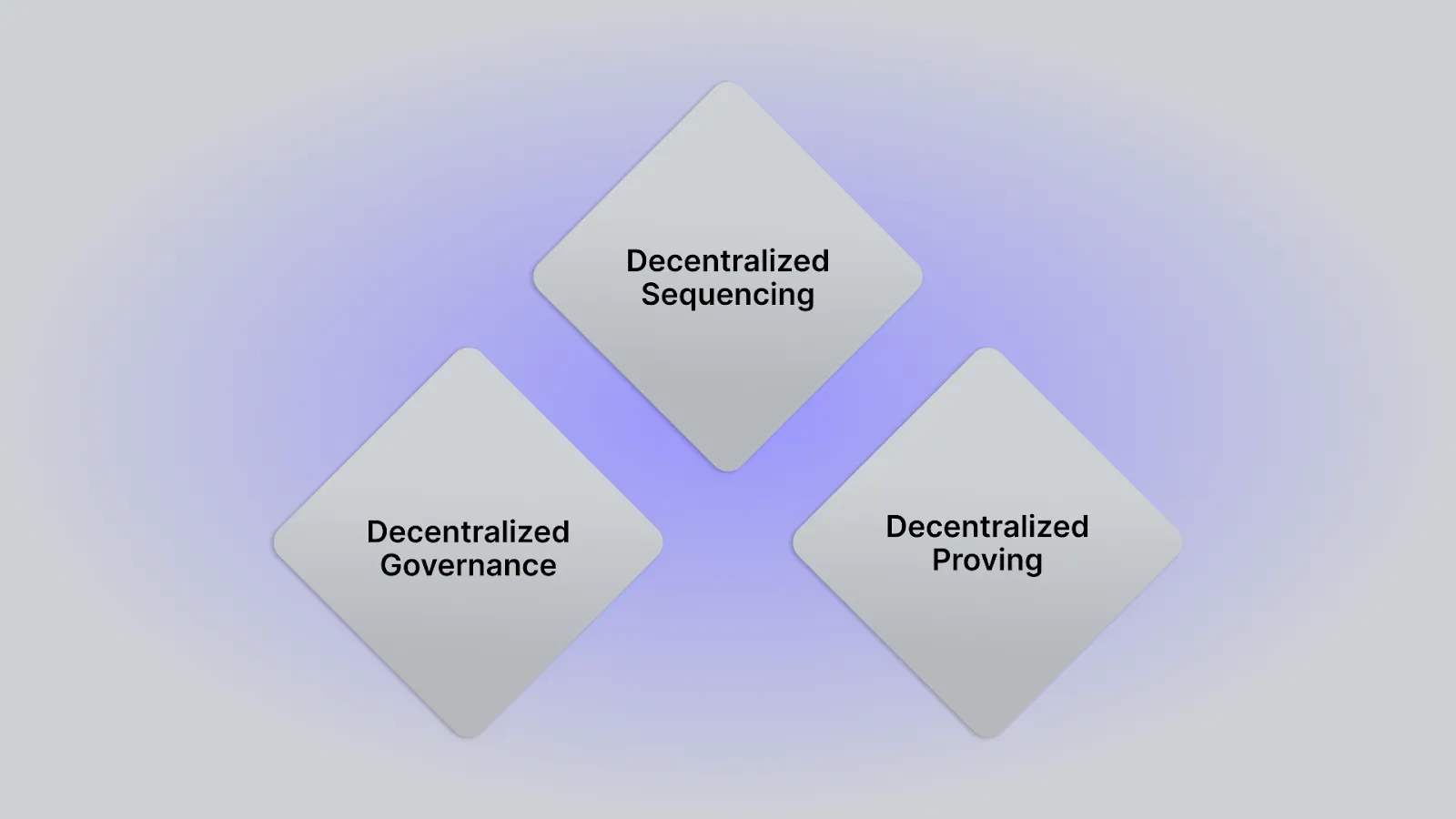
Decentralization across sequencing, proving, and governance is essential to ensure that no single party can control or censor the network. Decentralized sequencing guarantees open participation in block production, while decentralized proving ensures that block validation remains trustless and resilient, and finally, decentralized governance empowers the community to guide network evolution without centralized control. 

Together, these pillars secure the rollup’s autonomy and long-term trustworthiness. Let’s explore how Aztec’s Public Testnet is testing the implementation of each of these aspects. 

Decentralized sequencing

Aztec will launch with a fully decentralized sequencer network. 

This means that anyone can run a sequencer node and start sequencing transactions, proposing blocks to L1 and validating blocks built by other sequencers. The sequencer network is a proof-of-stake (PoS) network like Ethereum, but differs in an important way. Rather than broadcasting blocks to every sequencer, Aztec blocks are validated by a randomly chosen set of 48 sequencers. In order for a block to be added to the L2 chain, two-thirds of the sequencers need to verify the block. This offers users fast preconfirmations, meaning the Aztec Network can sequence transactions faster while utilizing Ethereum for final settlement security. 

PoS is fundamentally an anti-sybil mechanism—it works by giving economic weight to participation and slashing malicious actors. At the time of Aztec’s mainnet, this will allow sequencers to vote out bad actors and burn their staked assets. On the Public Testnet, where there are no real economic incentives, PoS doesn't function properly. To address this, we introduced a queue system that limits how quickly new sequencers can join, helping to maintain network health and giving the network time to react to potential malicious behavior.

Behind the scenes, a contract handles sequencer onboarding—it mints staking assets, adds sequencers to the set, and can remove them if necessary. This contract is just for Public Testnet and will be removed on Mainnet, allowing us to simulate and test the decentralized sequencing mechanisms safely.

Decentralized proving 

Aztec will also launch with a fully decentralized prover network. 

Provers generate cryptographic proofs that verify the correctness of public transactions, culminating in a single rollup proof submitted to Ethereum. Decentralized proving reduces centralization risk and liveness failures, but also opens up a marketplace to incentivize fast and efficient proof generation. The proving client developed by Aztec Labs involves three components: 

  1. Prover nodes identify unproven epochs (set of 32 blocks) and create individual proving jobs;

  2. Proving brokers add these proving job requests to a queue and allocate them to idle proving agents; and

  3. Proving agents compute the actual proofs. 

Once the final proof has been computed, the proving node sends the proof to L1 for verification. The Aztec Network splits proving rewards amongst everyone who submits a proof on time, reducing centralization risk where one entity with large compute dominates the network. 

For Aztec’s Public Testnet, anyone can spin up a prover node and start generating proofs. Running a prover node is more hardware-intensive than running a sequencer node, requiring ~40 machines with an estimated 16 cores and 128GB RAM each. Because running provers can be cost-intensive and incur the same costs on a testnet as it will on mainnet, Aztec’s Public Testnet will throttle transactions to 0.2 per second (TPS). 

Keeping transaction volumes low allows us to test a fully decentralized prover network without overwhelming participating provers with high costs before real network incentives are in place. 

Decentralized governance

Finally, Aztec will launch with fully decentralized governance. 

In order for network upgrades to occur, anyone can put forward a proposal for sequencers to consider. If a majority of sequencers signal their support, the proposal gets sent to a vote. Once it passes the vote, anyone can execute the script that will implement the upgrade. Note: For this testnet, the second phase of voting will be skipped. 

Decentralized governance is an important step in enabling anyone to participate in shaping the future of the network. The goal of the public testnet is to ensure the mechanisms are functioning properly for sequencers to permissionlessly join and control the Aztec Network from day 1. 

Client-side proofs 

One additional aspect to consider with regard to full decentralization is the role of network users in decentralizing the compute load of the network.

Aztec Labs has developed groundbreaking technology to make end-to-end programmable privacy possible. First with the release of Plonk, and later refinements like MegaHonk, which make it feasible to generate client-side ZKPs. Client-side proofs keep sensitive data on the user’s device while still enabling users to interact with and store this information privately onchain. They also help to scale throughput by pushing execution to users. This decentralizes the compute requirements and means users can execute arbitrary logic in their private functions.

Sequencers and provers on the Aztec Network are never able to see any information that users or applications want to keep private, including accounts, activity, balances, function execution, or other data of any kind. 

Aztec’s Public Testnet is shipping with a full execution environment, including the ability to create client-side proofs in the browser. Here are some time estimations to expect for generating private, client-side proofs: 

  • Client-side proofs natively on laptop: ~2.5 seconds for a basic function call (i.e, transfers);

  • Client-side proofs in browser: ~25 seconds fixed cost for basic function call, incremental calls add a few seconds; and
     
  • Client-side proofs natively on mobile: ~5 seconds.

Conclusion

Aztec’s Public Testnet is designed to rigorously test decentralization across sequencing, proving, and governance ahead of our mainnet launch. The network design ensures no single entity can control or censor activity, empowering anyone to participate in sequencing transactions, generating proofs, and proposing governance changes. 

Visit the Aztec Testnet page to start building with programmable privacy and join our community on Discord.

Read more
Aztec Network
Aztec Network
13 Nov
xx min read

The ticker is $AZTEC

We invented the math. We wrote the language. Proved the concept and now, we’re opening registration and bidding for the $AZTEC token today, starting at 3 pm CET. 

The community-first distribution offers a starting floor price based on a $350 million fully diluted valuation (FDV), representing an approximate 75% discount to the implied network valuation (based on the latest valuation from Aztec Labs’ equity financings). The auction also features per-user participation caps to give community members genuine, bid-clearing opportunities to participate daily through the entirety of the auction. 

How to Check Eligibility and Submit Your Bid 

The token auction portal is live at: sale.aztec.network

  • This is the only valid link to the $AZTEC token auction site. Be cautious of phishing scams. No one from the Aztec team will ever contact you directly for seed phrase or private keys. 
  • Visit the site to verify your eligibility and mint a soul-bound NFT that confirms your participation rights. 
  • We have incorporated zero-knowledge proofs into the sale smart contracts by using ZKPassport's Noir circuits to ensure compliant sanctions checks without risking the privacy of our users. 
  • Registration and bidding for early contributors start today, November 13th, at 3 PM CET, with early contributors receiving one day of exclusive access before bidding opens to the general public.
  • The public auction will run from December 2nd, 2025, to December 6th, 2025, at which point tokens can be withdrawn and staked.

Why Are We Doing This? 

We’ve taken the community access that made the 2017 ICO era great and made it even better. 

For the past several months, we've worked closely with Uniswap Labs as core contributors on the CCA protocol, a set of smart contracts that challenge traditional token distribution mechanisms to prioritize fair access, permissionless, on-chain access to community members and the general public pre-launch. This means that on day 1 of the unlock, 100% of the community's $AZTEC tokens will be unlocked.

This model is values-aligned with our Core team and addresses the current challenges in token distribution, where retail participants often face unfair disadvantages against whales and institutions that hold large amounts of money. 

Early contributors and long-standing community members, including genesis sequencers, OG Aztec Connect users, network operators, and community members, can start bidding today, ahead of the public auction, giving those who are whitelisted a head start and early advantage for competitive pricing. Community members can participate by visiting the token sale site to verify eligibility and mint a soul-bound NFT that confirms participation rights. 

To read more about Aztec’s fair-access token sale, visit the economic and technical whitepapers and the token regulatory report.

Discount Price Disclaimer: Any reference to a prior valuation or percentage discount is provided solely to inform potential purchasers of how the initial floor price for the token sale was calculated. Equity financing valuations were determined under specific circumstances that are not comparable to this offering. They do not represent, and should not be relied upon as, the current or future market value of the tokens, nor as an indication of potential returns. The price of tokens may fluctuate substantially, the token may lose its value in part or in full, and purchasers should make independent assessments without reliance on past valuations. No representation or warranty is made that any purchaser will achieve profits or recover the purchase price.

Information for Persons in the UK: This communication is directed only at persons outside the UK. Persons in the UK are not permitted to participate in the token sale and must not act upon this communication.

MiCA Disclaimer: Any crypto-asset marketing communications made from this account have not been reviewed or approved by any competent authority in any Member State of the European Union. Aztec Foundation as the offeror of the crypto-asset is solely responsible for the content of such crypto-asset marketing communications. The Aztec MiCA white paper has been published and is available here. The Aztec Foundation can be contacted at hello@aztec.foundation or +41 41 710 16 70. For more information about the Aztec Foundation, visit https://aztec.foundation.

Aztec Network
Aztec Network
28 Oct
xx min read

Your Favorite DeFi Apps, Now With Privacy

Every time you swap tokens on Uniswap, deposit into a yield vault, or vote in a DAO, you're broadcasting your moves to the world. Anyone can see what you own, where you trade, how much you invest, and when you move your money.

Tracking and analysis tools like Chainalysis and TRM are already extremely advanced, and will only grow stronger with advances in AI in the coming years. The implications of this are that the ‘pseudo-anonymous’ wallets on Ethereum are quickly becoming linked to real-world identities. This is concerning for protecting your personal privacy, but it’s also a major blocker in bringing institutions on-chain with full compliance for their users. 

Until now, your only option was to abandon your favorite apps and move to specialized privacy-focused apps or chains with varying degrees of privacy. You'd lose access to the DeFi ecosystem as you know it now, the liquidity you depend on, and the community you're part of. 

What if you could keep using Uniswap, Aave, Yearn, and every other app you love, but with your identity staying private? No switching chains. Just an incognito mode for your existing on-chain life? 

If you’ve been following Aztec for a while, you would be right to think about Aztec Connect here, which was hugely popular with $17M TVL and over 100,000 active wallets, but was sunset in 2024 to focus on bringing a general-purpose privacy network to life. 

Read on to learn how you’ll be able to import privacy to any L2, using one of the many privacy-focused bridges that are already built. 

The Aztec Network  

Aztec is a fully decentralized, privacy-preserving L2 on Ethereum. You can think of Aztec as a private world computer with full end-to-end programmable privacy. A private world computer extends Ethereum to add optional privacy at every level, from identity and transactions to the smart contracts themselves. 

On Aztec, every wallet is a smart contract that gives users complete control over which aspects they want to make public or keep private. 

Aztec is currently in Testnet, but will have multiple privacy-preserving bridges live for its mainnet launch, unlocking a myriad of privacy preserving features.

Bringing Privacy to You

Now, several bridges, including Wormhole, TRAIN, and Substance, are connecting Aztec to other chains, adding a privacy layer to the L2s you already use. Think of it as a secure tunnel between you and any DeFi app on Ethereum, Arbitrum, Base, Optimism, or other major chains.

Here's what changes: You can now use any DeFi protocol without revealing your identity. Furthermore, you can also unlock brand new features that take advantage of Aztec’s private smart contracts, like private DAO voting or private compliance checks. 

Here's what you can do:

  • Use DeFi without revealing your portfolio: trade on Uniswap or deposit into Yearn without broadcasting your strategy to the world
  • Donate to causes without being tracked: support projects on Base without linking donations to your identity
  • Vote in DAOs without others seeing your choices: participate in governance on Arbitrum while keeping your votes private
  • Prove you're legitimate without doxxing yourself: pass compliance checks or prove asset ownership without revealing which specific assets you hold
  • Access exclusive perks without revealing which NFTs you own: unlock token-gated content on Optimism without showing your entire collection

The apps stay where they are. Your liquidity stays where it is. Your community stays where it is. You just get a privacy upgrade.

How It Actually Works 

Let's follow Alice through a real example.

Alice wants to invest $1,000 USDC into a yield vault on Arbitrum without revealing her identity. 

Step 1: Alice Sends Funds Through Aztec

Alice moves her funds into Aztec's privacy layer. This could be done in one click directly in the app that she’s already using if the app has integrated one of the bridges. Think of this like dropping a sealed envelope into a secure mailbox. The funds enter a private space where transactions can't be tracked back to her wallet.

Step 2: The Funds Arrive at the DeFi Vault

Aztec routes Alice's funds to the Yearn vault on Arbitrum. The vault sees a deposit and issues yield-earning tokens. But there's no way to trace those tokens back to Alice's original wallet. Others can see someone made a deposit, but they have no idea who.

Step 3: Alice Gets Her Tokens Back Privately

The yield tokens arrive in Alice's private Aztec wallet. She can hold them, trade them privately, or eventually withdraw them, without anyone connecting the dots.

Step 4: Alice Earns Yield With Complete Privacy

Alice is earning yield on Arbitrum using the exact same vault as everyone else. But while other users broadcast their entire investment strategy, Alice's moves remain private. 

The difference looks like this:

Without privacy: "Wallet 0x742d...89ab deposited $5,000 into Yearn vault at 2:47 PM"

With Aztec privacy: "Someone deposited funds into Yearn vault" (but who? from where? how much? unknowable).

In the future, we expect apps to directly integrate Aztec, making this experience seamless for you as a user. 

The Developers Behind the Bridges 

While Aztec is still in Testnet, multiple teams are already building bridges right now in preparation for the mainnet launch.

Projects like Substance Labs, Train, and Wormhole are creating connections between Aztec and major chains like Optimism, Unichain, Solana, and Aptos. This means you'll soon have private access to DeFi across nearly every major ecosystem.

Aztec has also launched a dedicated cross-chain catalyst program to support developers with grants to build additional bridges and apps. 

Unifying Liquidity Across Ethereum L2s

L2s have sometimes received criticism for fragmenting liquidity across chains. Aztec is taking a different approach. Instead, Aztec is bringing privacy to the liquidity that already exists. Your funds stay on Arbitrum, Optimism, Base, wherever the deepest pools and best apps already live. Aztec doesn't compete for liquidity, it adds privacy to existing liquidity.

You can access Uniswap's billions in trading volume. You can tap into Aave's massive lending pools. You can deposit into Yearn's established vaults, all without moving liquidity away from where it's most useful.

The Future of Private DeFi

We’re rolling out a new approach to how we think about L2s on Ethereum. Rather than forcing users to choose between privacy and access to the best DeFi applications, we’re making privacy a feature you can add to any protocol you're already using. As more bridges go live and applications integrate Aztec directly, using DeFi privately will become as simple as clicking a button—no technical knowledge required, no compromise on the apps and liquidity you depend on.

While Aztec is currently in testnet, the infrastructure is rapidly taking shape. With multiple bridge providers building connections to major chains and a dedicated catalyst program supporting developers, the path to mainnet is clear. Soon, you'll be able to protect your privacy while still participating fully in the Ethereum ecosystem. 

If you’re a developer and want a full technical breakdown, check out this post. To stay up to date with the latest updates for network operators, join the Aztec Discord and follow Aztec on X.

Aztec Network
Aztec Network
22 Oct
xx min read

Bringing Private Over-The-Counter (OTC) Swaps to Crypto

Transparent OTC Trades Are Holding the Industry Back

OTC trading is fundamental to how crypto markets function. It enables better price negotiations than what you'll find on public order books and facilitates trading of illiquid assets that barely exist on exchanges. Without OTC markets, institutional crypto trading would be nearly impossible. But here's the massive problem: every single OTC transaction leaves a permanent, public trace. 

Let's say you're a fund manager who needs to sell 1,000 BTC for USDC on Base. In a traditional OTC trade, your Bitcoin leaves your wallet and becomes visible to everyone on Bitcoin's blockchain. Through cross-chain settlement, USDC then arrives in your Base wallet, which is also visible to everyone on Base's blockchain. 

At this point, block explorers and analytics firms can connect these transactions through pattern analysis. As a result, your trading patterns, position sizes, and timing become public data, exposing your entire strategy.

This isn't just about privacy; transparent OTC creates serious operational and strategic risks. These same concerns have moved a significant portion of traditional markets to private off-exchange trades. 

Why Traditional Finance Moved to Private Markets

In TradFi, institutions don't execute large trades on public order books for many reasons. In fact, ~13% of all stocks in the US are now traded in dark pools, and more than 50% of trades are now off-exchange. 

They use private networks, dark pools, and OTC desks specifically because:

  • Strategy Protection: Your competitors can't front-run your moves
  • Better Execution: No market impact from revealing large positions
  • Regulatory Compliance: Meet reporting requirements without public disclosure
  • Operational Security: Protect proprietary trading algorithms and relationships

While OTC trading is already a major part of the crypto industry, without privacy, true institutional participation will never be practical. 

Now, Aztec is making this possible. 

Moving Whale-Sized Bags Privately on Aztec

We built an open-source private OTC trading system using Aztec Network's programmable privacy features. Because Aztec allows users to have private, programmable, and composable private state, users aren’t limited to only owning and transferring digital assets privately, but also programming and composing them via smart contracts.

If you’re new to Aztec, you can think of the network as a private world computer, with full end-to-end programmable privacy. A private world computer extends Ethereum to add optional privacy at every level, from identity and transactions to the smart contracts themselves. 

To build a private OTC desk, we leveraged all these tools provided by Aztec to implement a working proof of concept. Our private OTC desk is non-custodial and leverages private smart contracts and client-side proving to allow for complete privacy of the seller and buyer of the OTC.

How It Actually Works

For Sellers:

  1. Deploy a private escrow contract (only you know it exists at this stage)
  2. Initialize contract and set the terms (asset type, quantity, price)
  3. Deposit your assets into the contract
  4. After it’s been deployed, call a private API (the order book service)

For Buyers:

  1. Discover available orders through our privacy-preserving API
  2. Select trades that match your criteria
  3. Complete the seller's partial note with your payment
  4. Execute atomic swap – you get their assets, they get your payment

The Magic: Partial Notes are the technical breakthrough that make collaborative, asynchronous private transactions possible. Sellers create incomplete payment commitments that buyers can finish without revealing the seller's identity. It's like leaving a blank check that only the right person can cash, but neither party knows who the other is.

Privacy guarantees include: 

  • Complete Privacy: Neither party knows who they're trading with
  • Strategy Protection: Your trading patterns stay private
  • Market Impact Minimization: No public signals about large movements
  • Non-custodial: Direct peer-to-peer settlement, no intermediaries

Key Innovations

Private Contract Deployment: Unlike public decentralized exchanges where smart contracts are visible on the blockchain, the escrow contracts in this system are deployed privately, meaning that only the participants involved in the transaction know these contracts exist.

Partial Note Mechanism: This system uses cryptographic primitives that enable incomplete commitments to be finalized or completed by third parties, all while preventing those third parties from revealing or accessing any pre-existing information that was part of the original commitment.

Privacy-Preserving Discovery: The orderflow service maintains knowledge of aggregate trading volumes and overall market activity, but it cannot see the details of individual traders, including their specific trade parameters or personal identities.

Atomic Execution: The smart contract logic is designed to ensure that both sides of a trade occur simultaneously in a single atomic operation, meaning that if any part of the transaction fails, the entire transaction is rolled back and neither party's assets are transferred.

Build with us!

Our prototype for this is open-sourced here, and you can read about the proof of concept directly from the developer here

We're inviting teams to explore, fork, and commercialize this idea. The infrastructure for private institutional trading needs to exist, and Aztec makes it possible today. Whether you're building a private DEX, upgrading your OTC desk, or exploring new DeFi primitives, this codebase is your starting point. 

The traditional finance world conducts trillions in private OTC trades. It's time to bring that scale to crypto, privately.

To stay up to date with the latest updates for network operators, join the Aztec Discord and follow Aztec on X.

Aztec Network
Aztec Network
15 Oct
xx min read

Your Private Money Yearns for a Private Economy

Watch this: Alice sends Zcash. Bob receives USDC on Aztec. Nobody, not even the system facilitating it, knows who Alice or Bob are.

And Bob can now do something with that money. Privately.

This is the connection between private money and a private economy where that money can actually be used.

Zcash has already achieved something monumental: truly private money. It’s the store of value that Bitcoin promised (but made transparent). Like, digital gold that actually stays hidden.

But here's the thing about gold - you don't buy coffee with gold bars. You need an economy where that value can flow, work, and grow. Privately.

Money Under the Mattress

While other projects are trying to bolt privacy onto existing chains as an afterthought, Zcash is one of the oldest privacy projects in Web3. It's achieved what dozens of projects are still chasing: a truly private store of value.

Total Shielded ZEC Value (USD): Sep 16 - Oct 14 | Source: zkp.baby/

This is critical infrastructure for freedom. The ability to store value privately is a fundamental right, a hedge against surveillance, and a given when using cash. We need a system that provides the same level of privacy guarantees as cash. Right now, there's over $1.1 billion sitting in Zcash's shielded pool, private wealth that's perfectly secure but essentially frozen.

Why frozen? Because the moment that shielded $ZEC tries to do anything beyond basic transfers: earn yield, get swapped for stablecoins, enter a liquidity pool, it must expose itself. The privacy in this format is destroyed.

This isn't Zcash's failure. They built exactly what they set out to build: the world's best private store of value. The failure is that the rest of crypto hasn't built where that value can actually work.

The Privacy Landscape Has an Imbalance

What happens when you want to do more than just send money? What happens when you want privacy after you transfer your money?

Private Digital Money (i.e., “Transfer Privacy,” largely solved by Zcash):

  • Zcash: est. 2016
  • Everyone else: building variants of digital money at the transaction or identity level
    • Monero
    • Ethereum privacy pools
    • 0xbow
    • Payy
    • Every privacy stablecoin project
    • Every confidential L2
    • Every privacy project you've ever heard of

Private World Computer (i.e., After-the-Transfer Privacy):

  • Aztec

Everyone else is competing to build better ways to hide money. Zcash has already built the private store of value, and Aztec has built the only way to use hidden money.

The Locked Liquidity Problem

Here's the trillion-dollar question: What good is private money if you can't use it?

Right now, Zcash's shielded pool contains billions in value. This is money in high-security vaults. But unlike gold in vaults that can be collateralized, borrowed against, or deployed, this private value just sits there.

Every $ZEC holder faces two impossible choices:

  1. Keep it shielded and forfeit all utility
  2. Unshield it to use it and forfeit all privacy

Our demo breaks this false sense of choice. For the first time, shielded value can move to a place where it remains private AND becomes useful.

The Private World Computer

Here's how you can identify whether you’re dealing with a private world computer, or just private digital money:

Without a private world computer (every other privacy solution):

  • Receive salary privately → Can't invest it
  • Store savings privately → Can't earn yield
  • Send money privately → Recipient can't use it privately

With a private world computer (only Aztec):

  • Receive salary privately → Invest it privately
  • Store savings privately → Earn APY privately
  • Send payment privately → Recipient spends it privately

This is basic financial common sense. Your money should grow. It should work. It should be useful.

The technical reality is that this requires private smart contracts. Aztec is building the only way to interact privately with smart contracts. These smart contracts themselves can remain completely hidden. Your private money can finally do what money is supposed to do: work for you.

What We Actually Built

Our demo proves these two worlds can connect:

  1. The Vault: Zcash
  2. The Engine: Aztec (where private money becomes useful)

We built the bridge between storing privately and doing privately.

The technical innovation - "partial notes" - are like temporary lockboxes that self-destruct after one use. Money can be put privately into these lockboxes, and a key can be privately handed to someone to unlock it. No one knows who put the money in, where the key came from, or who uses the key. You can read more about how they work here. But what matters isn't the mechanism. 

What matters is that Alice's Zcash can become Bob's working capital on Aztec without anyone knowing about either of them.

As a result, Bob receives USDC that he can:

  • Earn yield on
  • Trade with
  • Pay suppliers with
  • Build a business on
  • All privately

Why This Required Starting from Scratch (and 8 years of building)

You can't bolt privacy onto existing systems. You can't take Ethereum and make it private. You can't take a transparent smart contract platform and add privacy as a feature.

Aztec had to be built from the ground up as a private world computer because after-the-transfer privacy requires rethinking everything:

  • How state is managed
  • How contracts execute
  • How proofs are generated
  • How transactions are ordered

This is why there's only one name building fully private smart contracts. From the beginning, Aztec has been inspired by the work Zcash has done to create a private store of value. That’s what led to the vision for a private world computer.

Everyone else is iterating on the same transfer privacy problem. Aztec solves a fundamentally different problem.

The Obvious Future

Once you see it, you can't unsee it: Privacy without utility is only the first step.

Every privacy project will eventually need what Aztec built. Because their users will eventually ask: "Okay, my money is private... now what?"

  • Zcash users will want their $ZEC to earn yield
  • Privacy pool users will want to do more than just mix
  • Private stablecoin users will want to actually… use their stablecoins

This demo that connects Zcash to Aztec is the first connection between the old world (private transfers) and the new world (private everything else).

What This Means

For Zcash Holders: Your shielded $ZEC can finally do something without being exposed.

For Developers: Stop trying to build better mattresses to hide money under. Start building useful applications on the only platform that keeps them private. 

For the Industry: The privacy wars are over. There's transfer privacy (solved by Zcash) and after-the-transfer privacy (just Aztec).

What’s Next? 

This demo is live. The code is open source. The bridge between private money and useful private money exists.

But this is just the beginning. Every privacy project needs this bridge. Every private payment network needs somewhere for those payments to actually be used.

We're not competing with transfer privacy. We're continuing it.

Your private money yearns for the private economy.

Welcome to after-the-transfer privacy. Welcome to Aztec.