All blockchains today – L1s, L2s, and shielded pools – make use of elliptic curves somewhere in their stack.
Elliptic curves are used in all sorts of places: signing transactions, validator attestations, data availability (such as blobs), zk-snarks, secret sharing, encryption, etc.
No cryptocurrency project today is 100% quantum-proof.
Nobody has a reliable date for when a quantum computer will break the elliptic-curve cryptography we use today, but we know it’s coming.
For a privacy network, some of the work cannot wait for that uncertainty to resolve. An attacker could collect encrypted data today and keep it until they have the means to decrypt it. This is the so-called “Harvest now; decrypt later” attack. Replacing an encryption scheme ten years from now would not protect the data an attacker already harvested under a classical encryption scheme.
Aztec is already quantum resistant against this type of attack. It was designed from the ground up to allow users to bunker-proof their accounts and data against quantum computers.
However, there is work to be done to make Aztec fully quantum secure and able to function with full privacy in the post-quantum world.
Our roadmap to expand our quantum security has two targets:
- February 2027: Hardened libraries and better off-the-shelf contract development patterns that protect against harvest-now-decrypt-later attacks
- 2030: a full post-quantum migration.
The first requires changes to how applications handle private data. The second reaches into the proving system, account authentication, key derivation, validator signatures and Ethereum settlement. Understanding why these need different schedules requires getting into the cryptography.
The risk of changing cryptography
Years of hard-won experience have taught us that the greatest risk to a network like Aztec is implementation bugs. Our AI audit harness has found critical vulnerabilities, including ones that months of expert human internal and external audits didn’t find. These have been patched in the upcoming v6 Aztec Network release. We have spent the past 18 months hardening our software and cryptography. That work has to continue while we develop their replacements.
AI also changes cryptanalysis. For example, the attack on HAWK (a post-quantum signature scheme) exploited structure specific to that signature scheme and reduced its security enough to end its candidacy for standardization. That is a reason to examine the assumptions and structure of each scheme with care.
Rushing headfirst into new cryptography that has not faced enough scrutiny would expose users to immediate risks, greater than the speculative risks of quantum computers. The Foundation has finite resources, and time spent on the post-quantum migration is time we have to balance against securing the software users depend on today.
Our default approach to changing cryptography is conservative. Any changes to our protocols must be justified, subjected to extraordinary cryptanalysis and have formally-verified implementations.
Making Aztec post-quantum
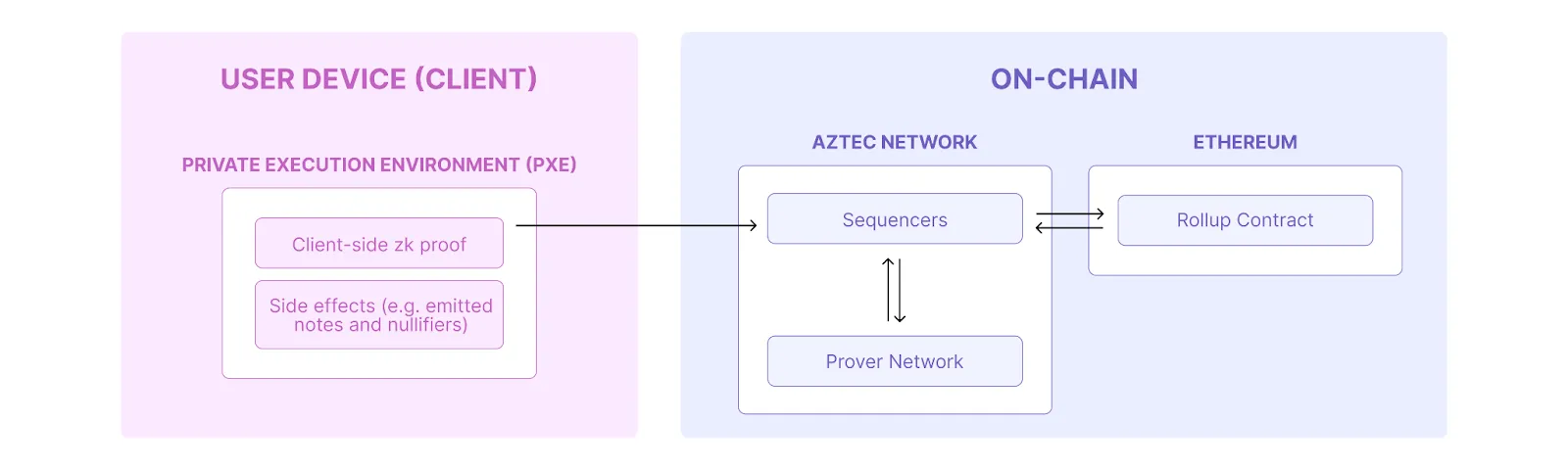
To make Aztec post-quantum requires several pieces of cryptography. Aztec has an application layer (smart contracts), the Aztec protocol layer, and it settles on Ethereum itself. All three have responsibilities with respect to post-quantum security.
Protocol layer changes required:
1. Proving System
- A post-quantum zero-knowledge proving system. Our unique requirements as a decentralized programmable privacy protocol present unique challenges, explained later.
2. Addresses & Keys
- Changes to Aztec addresses and public keys, which are all elliptic curve points.
- (These current addresses & keys can be used in a quantum-safe way today, though).
- Validator Keys & Signatures:
- post-quantum digital signature scheme for Aztec’s decentralised validators’ attestations.
- Adoption of the required Ethereum changes outlined below.
Application layer changes required:
- Post-quantum digital signature schemes.
- Post-quantum KEMs (secret sharing mechanisms).
- Post-quantum public-key encryption.
Ethereum changes required:
- DA
- A DA layer that doesn’t use BLS12-381 KZG commitments.
- Verification Primitives
- Cheap post-quantum snark verification primitives, as an alternative to the currently cheap de facto BN254 EVM precompiles.
- Public Keys & Signatures
- Ethereum EoA public keys and signatures
- Ethereum’s BLS keys.
The latter application layer requirements are not on Ethereum’s post-quantum roadmap as they’re a unique requirement of privacy protocols like Aztec and ZCash.
Notice that the bulk of the changes required for user privacy are dictated by the choices of Aztec smart contract developers at the application layer. Apps can adopt post-quantum encryption and signature schemes today on Aztec, and different Aztec smart contract developers can freely explore differing approaches as the state of the art in post-quantum advances.
Protecting private data now
If and when quantum computers arrive, Aztec is already (uniquely for privacy protocols) protected in two key categories because of our existing design choices.
- A post-quantum proof system can securely use historical state created today
- By default, historical state (including encrypted logs) is not vulnerable to “harvest-now-decrypt-later” attacks
“Traditional” messaging in privacy protocols
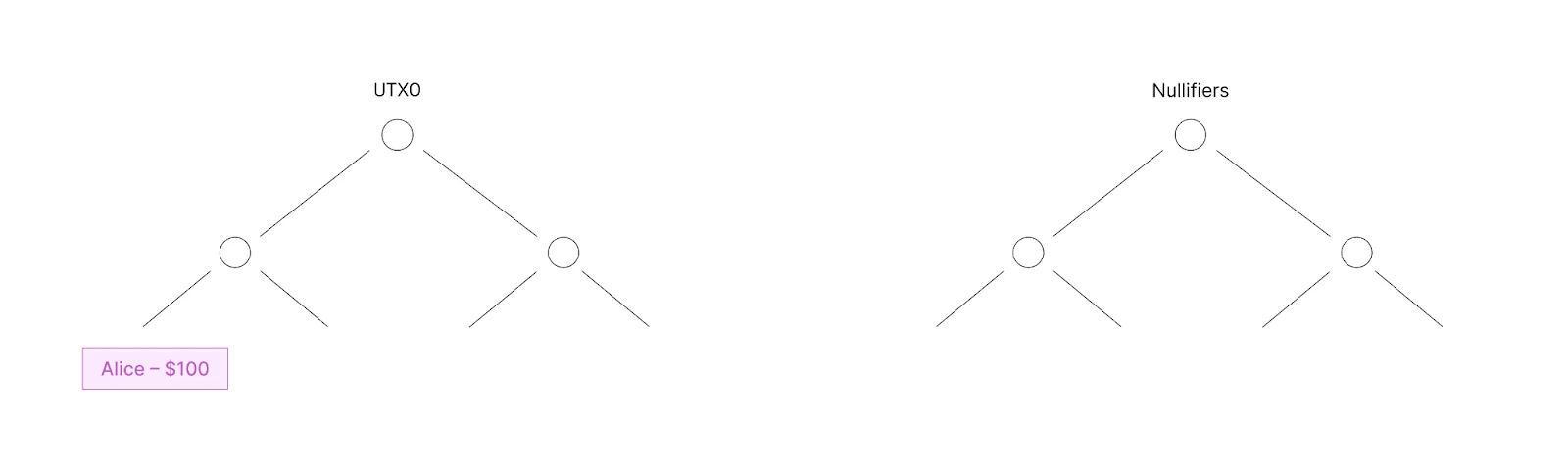
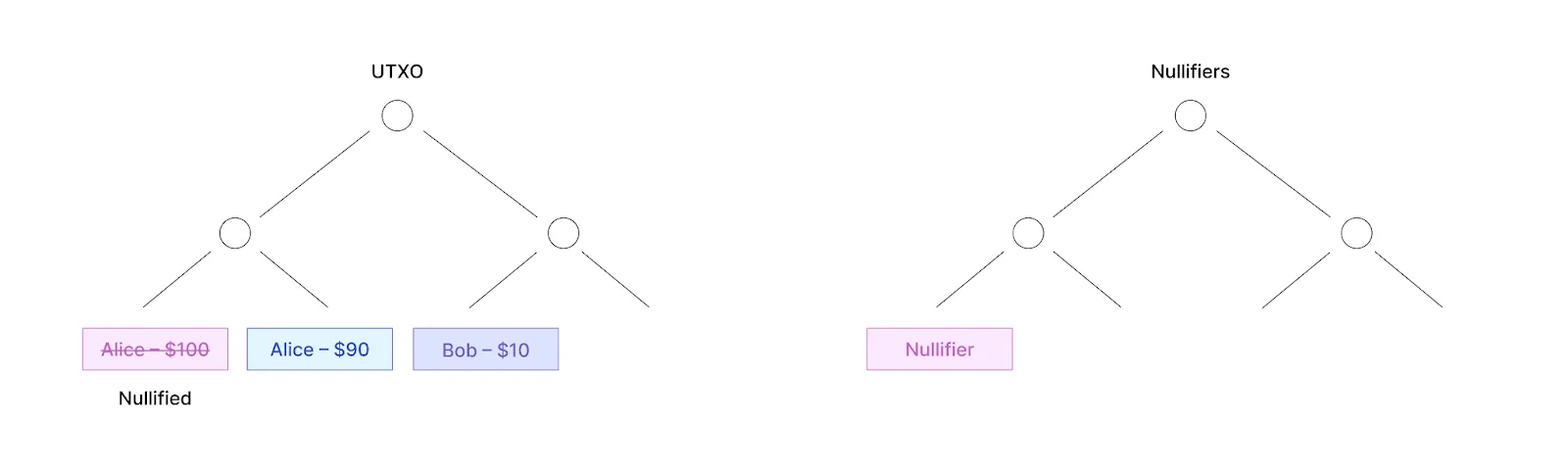
If I send you private tokens, there’s no onchain public balance update for you to see or query. Private state is stored in notes, so I need to tell you about the existence and contents of your new note for you to be able to use it.
A common solution is for me to publish an encrypted message to a public bulletin board that your wallet can find and decrypt. ZCash pioneered this approach.
Elliptic curve key exchange protocols are well-suited to this, because the amount of data I need to publish to convey “this is for you” and “here’s the ephemeral key you’ll need to decrypt this message” is a single ECDH ephemeral public key; an elliptic curve point; a tiny 32 bytes of info. We like this small communication overhead, because less data means faster tx throughput and cheaper DA costs passed on to users.
But elliptic-curve key exchanges can create a harvest-now-decrypt-later risk. The discrete log of such an ephemeral public key will one day be solvable by a quantum adversary. They could derive all ephemeral secret keys of all messages in the bulletin board. They’d then be able to brute-force combine the resulting list of ephemeral secret keys with a list of all known users’ viewing public keys to effectively derive all decryption keys on the network, to then decrypt all encrypted messages. They’d learn the contents of the note I sent you: the amount and that it belongs to you.
There are a few classical (pre-quantum) solutions to this. They follow from the observation that if an attacker doesn’t know one of: your public key or the ephemeral public key, then they won’t have enough information to decrypt any of your encrypted messages! Wallets are beginning to adopt the following:
- Don’t publicly share your public keys.
- This is easier said than done. It defies the initial design intentions of public key cryptography. After all, you’d need to give me your public key for me to send you money! What if you share it with a dishonest counterparty, or an honest counterparty whose data leaks accidentally? This leads to another protection:
- Use a new public key for every new transaction.
- That way, you stem any leakage if any of those public keys does leak. Some wallets of some privacy protocols already do this.
- Don’t broadcast any ephemeral public keys to a public bulletin board.
- If ephemeral public keys aren’t seen by a quantum adversary, they can’t decrypt your messages, regardless of whether your address is public. Share this data through some private communication channel instead.
Aztec Public Keys are hashed
Intentionally, most of the public keys in the Aztec protocol are hashed to reduce their leakage to a future post-quantum adversary. The public keys are not even exposed to Aztec smart contracts (which could be malicious).
(Private smart contract protocols even have a niche “harvest now; link later” attack to protect against, whereby a quantum adversary could link all your notes and nullifiers together to reconstruct your entire tx graph. Hashing the nullifier public key resolves this).
Aztec is flexible, today
The Aztec Protocol is agnostic to the way in which users and applications (smart contracts) share private information between each other. It’s a beautifully flexible protocol because we knew times would change. Smart contract developers can adopt the above conventions today, and indeed many are doing so.
Aztec smart contracts can emit arbitrary bytes of data as “private logs”. These private logs are the intended delivery mechanism for sending encrypted notes. It’s up to smart contract developers how they populate those logs. I.e. they can choose:
- Whether to use these private logs at all;
- How to get the recipient’s attention;
- How to convey the decryption key;
- Which encryption scheme to use.
Aztec also supports offchain note delivery, which gives applications another secure option. A sender delivers the message through an off-chain side channel that is not visible to harvest-now-decrypt-later attackers.
All this flexibility in today’s Aztec Protocol enables Aztec smart contract developers to explore the tradeoff space in a way that best serves their users and use cases. Choices will need to balance: proving speed; DA costs; discovery of pertinent notes; post-quantum threats.
Better libraries
Of course, most smart contract developers don’t want to think about such things, which is why the Aztec ecosystem has smart contract libraries with off-the-shelf solutions.
Our early 2027 work will focus on hardening these libraries and giving Aztec developers better patterns for protecting their users’ private data, with clear requirements for delivery and secret establishment.
Post-quantum secret sharing
A more comforting solution to post-quantum worries would be for Aztec smart contracts to instead adopt post-quantum secret sharing and encryption schemes.
We’re researching the best approaches and working on some tidy libraries. The good thing is, the agnosticism of the Aztec Protocol means multiple libraries for differing post-quantum secret sharing schemes can be written and adopted by different applications on Aztec.
Constrained Delivery
In most other privacy protocols, the construction of an encrypted note is not constrained by any circuit.
For example, if I send you ZCash tokens, the ‘transfer’ function does not constrain that I have correctly encrypted your note, nor that I have attached the correct ephemeral public key that would enable you to discover and decrypt your encrypted note. I could technically broadcast garbage and you wouldn’t receive your funds. That’s arguably fine in a “simple” transfer protocol. It’s not in my interest to corrupt the encrypted notes that I create for you. After all, you can just claim I didn’t pay you until you do receive a valid and decryptable message.
But when you generalise beyond simple transfers to private smart contracts, there are use cases whereby a sender might not be incentivised to deliver valid data to a recipient. The sender might actually prefer to corrupt a recipient’s data. Imagine a private swap. The contract should not complete the trade if one party receives a commitment to a note whose contents they cannot recover.
In such cases, the private functions (circuits) need to constrain that a recipient will be capable of discovering and decrypting a sender’s encrypted messages. Aztec’s smart contract libraries have rails for this so-called “constrained delivery”. If a use case assumes distrust between sender and recipient, the smart contract developer can enforce their correct adherence to the rules. The protocol then constrains that all private logs emitted by smart contracts are guaranteed to be broadcast – without tampering – to Ethereum blobs.
With this in mind, the constraints required to support post-quantum encryption then become a very important consideration. We’ll need post-quantum libraries that are efficient to prove.
Key and ciphertext sizes matter, but so does the cost of proving the key exchange, encryption and associated checks. A scheme can be fast as native software and expensive inside a circuit.
MIKE, published on 6 October, illustrates why this remains an active research question. It is an isogeny-based non-interactive key-exchange proposal. Its authors report 80-byte public keys and shared-secret computation, including key validation, in 4.9 milliseconds on a 3.3 GHz AMD CPU at their claimed NIST level 1.
Compact keys are attractive for note delivery. We still need to understand its circuit costs and give its security assumptions time to face scrutiny. Those native timings cannot tell us whether it is the right choice for Aztec.
The encryption and proving-system decisions therefore affect each other. Choosing encryption first and discovering that it is prohibitively expensive in the chosen prover would leave us rebuilding one of them.
Choosing the encryption scheme we will prove inside future post-quantum circuits is a separate, later milestone. Applications that need the contract itself to guarantee delivery impose harder requirements on that choice.
Post-Quantum Proving
Ok, so Aztec provides flexibility for good post-quantum privacy today. And we have plans to roll out even better post-quantum libraries.
But what about the proving system? A post-quantum adversary might be able to forge proofs. Thankfully we have some more time to choose a post-quantum proving system.
Aztec has several proving system requirements that other projects aren’t encumbered by (due to our commitment to both privacy, decentralisation and programmability), which we’ll elaborate on.
- Low memory and CPU requirements: proving must be possible on a phone, in the browser.
- Actual zero-knowledge!
- Fast client-side recursion.
- Small client-side proof sizes.
- Cheap L1 verification.
- Simple, maintainable, and secure.
Common benchmarks for proving system performance don’t take into consideration all these requirements. Fast client-side recursion in particular is often overlooked.
The problem with recursion
Aztec uses CHONK, an elliptic-curve and pairing-based proving system built around the requirements of private smart contracts. Users generate proofs on their own devices, and a transaction can involve several private contract calls. Recursion lets us combine those calls into a proof of the transaction without requiring the browser to handle the entire computation as one enormous circuit. CHONK’s design puts low memory use and recursive composition at its centre.
There are tradeoffs you can make to get a faster prover. Some give the verifier more work. A custom “precompile” circuit for an expensive operation can save the prover from executing that operation through thousands of VM instructions, but introduces additional commitments and checks that increases Verifier complexity.
The problem is that, in the recursive setting, your verifier is in your prover. The next proof has to establish that the verifier accepted the previous proof.
I have lost count of the conversations about new prover technology where recursion gets a handwave and a “we’ll deal with it later.” It is a complex, messy problem that is easy to postpone until you need users to generate private transaction proofs in a browser.
Some alternative designs might execute an entire function stack within a single VM instance. That might work for some bounded stack depth. But snarks are gaining traction in web2 too (see zkPassport for example). Bridging between chains also often requires snarks. Privacy protocols should be able to verify traditional snarks for as long as we remain in a pre-quantum world.
Zero knowledge introduces another set of costs. I have heard the same assurances that adding it will be easy and will not affect performance. From personal experience, such claims often disintegrate on contact with reality.
We thought adding zero knowledge to CHONK would be easy. It took us six months and a re-architecture of our recursive proving stack. Modern proof systems have such complexity that throwing randomness into the execution trace and calling it a day almost never works. Adding ZK typically increases proof size and verifier work, which then increases the cost of recursion.
The result is that the real cost of recursion in a production proving system, with all of the edge-cases and exceptions and little additions that pile up, is never as fast as the initial proof-of-concept claims. For Aztec that is a problem because recursion is essential and not an afterthought - we won’t commit to a proving system that can’t meet our extremely tight recursion requirements.
Luckily there are some candidates, and the Ethereum Foundation is doing trailblazing work as one of the few teams that has started to take this problem seriously.
Getting larger proofs through the network
Proof size matters because Aztec transactions travel through a peer-to-peer network. Every node that receives and forwards a proof pays its bandwidth cost. Aztec’s 20kb proofs are “ok”. If it ever becomes a bottleneck we can make them smaller with little effort because we use elliptic curves.
Post-quantum proof systems (the fast ones), on the other hand, have proofs of ~300KB, which is not ok.
Worse, there are zero post-quantum proving systems whose proofs are small enough to gossip across a p2p network whilst achieving acceptable transaction throughput. There are fundamental constraints which mean this is not likely to change!
Fast recursion offers another path. A node could receive two transaction proofs, produce one proof that establishes the validity of both, and forward the aggregate. Other nodes could repeat the process. Transaction data would still have to travel through the network, but the proof overhead could shrink across a batch.
Ethereum’s post-quantum research faces a related problem. Its proposed hash-based validator signatures lack BLS’s cheap native aggregation, so leanVM supplies a proof that many signatures pass verification. The draft EIP-8292 assigns that proving work to aggregators with suitable hardware. Their longer-term roadmap requires full virtual-machine proof aggregations which presents an extremely similar problem to ours.
For the Aztec approach to work on ordinary nodes, aggregation needs to be cheap. My working estimate is that two-to-one aggregation in roughly 20–100 milliseconds on a modern CPU could make it practical.
Nodes receive different transactions at different times, so they will duplicate work. An attacker may try to exploit that duplication. We need to establish how many aggregations one malicious transaction can induce and what happens to throughput under that load.
This problem is currently under-explored and poorly parametrised and substantial work needs to occur before a definitive solution can be decided on.
Which proving systems look promising?
The main candidates are hash-based systems over binary fields and small prime fields, lattice-based systems, and proposals that combine both prime-field and binary-field representations.
The Flock paper gives a good example of the progress in binary-field proving. Its authors report proving 660,000 BLAKE3 hashes per second on an M4 mac on ten cores.
These are impressive numbers. Hashing is a major part of verifying hash-based proofs, so cheap hashing is good for recursion.
However, binary field systems are weak with regards to integer multiplication. Trustless access to Web2 data is one of the biggest untapped capabilities of blockchain. Private applications should be able to use passport signatures, credit credentials, TLS-based data proofs and signed web tokens without publishing the underlying information. That means dealing with ugly Web2 cryptography: RSA, large-field elliptic curves and integer arithmetic.
Binary-field arithmetic does not behave like integer arithmetic. In particular, integer addition has carries, and multiplication needs a representation and a circuit that handles them. A BLAKE3 benchmark tells us little about the cost of proving a 4096-bit RSA verification. We need to measure the operations our applications will use.
That is what makes hybrid approaches interesting to me: using one commitment both in a binary representation and a prime field representation depending on context. This is an active area of research with limited existing published work, which highlights how rapidly evolving this space is.
Lattice-based proving deserves serious attention too. The Jolt team’s September release replaced the elliptic-curve commitment scheme Dory with Akita, based on Module-SIS. The authors reported faster proving and verification and proofs below 100 KB. Their announcement also described zero knowledge as forthcoming, so those figures do not settle our comparison.
Lattice commitments retain algebraic structure that could be useful for the kinds of composition we rely on. That makes them attractive candidates to investigate, although translating CHONK’s techniques would require work. The field size is a design choice we need to evaluate within each construction; lattices do not impose one universal 128-bit-field requirement.
Much of the suspicion around lattice systems rests on vibes about whether the underlying structure is vulnerable to AI cryptoanalysis. There are good reasons to scrutinize a particular assumption, parameter set or reduction. “It uses lattices” does not supply that scrutiny.
Not all lattice crypto is equal. The fundamental short-integer-solution hardness assumption has had decades of cryptanalysis. Lattice crypto has a degraded reputation because some modern protocols layer on additional, weaker hardness assumptions that have shown to be broken by quantum adversaries. But there is no quantitative evidence to suspect the core harness assumptions of lattice crypto are vulnerable.
Either way, the rate of development gives me confidence that we will have good options. It also makes choosing a winner today premature. We need comparisons that include our applications, recursion, zero knowledge and security parameters together.
Signatures
In Aztec transactions, digital signatures are private witnesses within private functions of smart contracts (zero-knowledge circuits), which helpfully means we don’t care so much about the size of an individual signature. This gives us more freedom than non-rollups e.g. Ethereum, where signature size directly contributes to their transaction size. This matters because post-quantum digital signatures are typically large.
Baking Bad
Similar to other privacy protocols such as ZCash Sapling and Orchard, several Aztec keys are baked-into the preimage of an Aztec address. To enable ‘post-quantumification’ of the Aztec protocol, we’re exploring externalising those keys to a canonical keystore registry. An Aztec address would then cease to be an elliptic-curve public key, and instead would simply be a hash which serves as a lookup into this registry. The registry could store all manner of exotic post-quantum public keys for different use cases.
Hash functions belong in the migration too
Aztec uses Poseidon2 throughout the protocol. Poseidon2 is technically post-quantum secure. And while Poseidon2 is secure for our chosen domain, recent breaks over small-field Poseidon signal that we should move to a different hash function in the long-term.
We’re confident that Poseidon2 will remain practically secure for many years, but the writing is on the wall and it would not be wise to use this hash function in Aztec’s future post-quantum system.
We will likely replace it with either Blake2s or Blake3. The Ethereum Foundation are also considering a canonical hash function for their post-quantum roadmap and we’ll more than likely follow their lead here. Binary-field proof systems can trivially handle BLAKE hashes so the need for Poseidon2 will have run its course.
Why the roadmap extends to 2030
Our proposed selection milestones are:
- March 2027: choose a post-quantum signature scheme.
- July 2027: choose a post-quantum public-key encryption scheme, with constrained note delivery benchmarked in the leading proof systems.
- November 2027: choose a post-quantum proving system.
The encryption milestone needs circuit measurements before we settle the proving-system choice. The proving-system decision needs working recursion and zero knowledge, alongside representative application workloads. These dates give us a sequence for answering those questions.
After selection, we need to replace the cryptography across the system. That includes addresses and key derivation, application-specific key checks inside the kernels, account authentication, validator authentication and the proof chain that ends on Ethereum. We also need to handle existing private state and give users and applications a migration path.
Ethereum supplies another dependency. Aztec’s final proof verification and blob commitments sit within Ethereum’s cryptographic infrastructure. A full post-quantum migration has to account for Ethereum’s upgrades as well as our own.
The roughly three years between the final selection milestone and end of year 2030 leave room for integration to expose problems that isolated benchmarks cannot. Development and integration of multiple novel post-quantum cryptographic primitives into Aztec will be neither simple nor fast. In addition, the entire tech stack will have to be formally verified due to the incredible threat that AI poses with regards to finding and exploiting bugs.
I think Q-day within four years is unlikely, and the roadmap is designed under the assumption that post-quantum work is not the sole focus and obsession of the Aztec Foundation. If there is evidence of faster progress in quantum hardware that would bring forward Q-day, we will be able to accelerate our roadmap by diverting resources to this project.
Developers will not have to wait for that full migration to make better choices about private data. The January work will provide hardened libraries and documented patterns to build against. A developer building a private application will be able to protect the data they create today to stand the test of time.