Vision
7 Mar
## min read

Regeneration: a Manifesto for an Autonomous Future

This piece, written by Zac Williamson with insights from Arnaud Schenk, delves into the evolving landscape of blockchain technology and its impact on societal structures.

Share
Written by
Zac Williamson
Edited by

The following is written by Zac Williamson, with inspiration and advice from Arnaud Schenk.

My fellow companions, my decentralized brothers and sisters. I wish to tell you a story, about complicated people and their struggles to resolve the wreckage of their contradictions. It is a story of humanity.

We are at a unique point in history and stand at the threshold of two worlds. One world is a propagation of our present, a status quo antebellum with all of its associated joys and sorrows.

There is another door, one hidden from view except for those with the sight to see it. You and I are here because we see a unique vision of the future, one of high technology and high ideals, that advance human beings from their status as a commodity resource in a globalized world, to free actors imbued with autonomy and purpose, who bow to no one.

I want to articulate this vision and examine the forces that drive us. Despite our successes and dedication it is clear that our current achievements fall short of our aspirations. We must reconcile this.

Bitcoin is not yet a credible threat to traditional currencies. Paying for goods and services with cryptocurrency is a niche luxury for the technologically well-connected. Decentralized autonomous organizations (DAOs) are yet to govern anything that is not a cryptocurrency project. A notable exception was ConstitutionDAO, which immediately failed in its goals due to the intrinsic limitations of trustless blockchain networks.

There are missing pieces in the technological armaments we have fashioned. I want to show you the missing pieces. I want to go back to the roots: what are the systems and frameworks we want to disrupt? Which properties do blockchain networks need for us to forge a conspiracy against the present, and fight for our vision of the future?

Control Factions

Reaching back into prehistory, humanity has been waging a war against itself – a war that pits the freedom and autonomy of individuals against the safety and control of institutions.

We want to be free. We want to be safe. This is the eternal contradiction.

To acquire safety we bind ourselves to institutions. Within these institutions, control factions form. They metastasize and act to entrench their power and influence by monopolizing human agency. This triggers inevitable conflict and revolt, which acts to reset the equilibrium.

How best we can resolve the contradiction between freedom and safety is a function of social organization, the quality of which is gated behind technological innovation.

Blockchain is one such technology. To identify what we need, we must identify the weaknesses of the institutions we seek to undermine, and tailor our strengths against them.

The competency crisis

Control factions have a fatal weakness: they reject competence.

Competent people threaten individuals within entrenched power structures. A competent subordinate is a threat to your power and privileges. This is the so-called “dictator trap”, but the mechanics at play extend to all power structures, from the boards of mega-corporations to the local residents association. But it’s not a dictator trap, it is an institution trap.

Power craves legibility and predictability and will act on these desires by exerting control – limiting agency and freedom of action.

Re-distributing institutional control

We want to undermine institutional control, and redistribute control down to smaller units of organization.

Blockchain technology enables such radical new forms of social organization that fall outside the frameworks of traditional institutions.

We possess a keystone technology that enables mass peer-to-peer coordination, initially of cryptocurrency assets but this can be generalized to anything with perceived value that can be given a digital fingerprint.

Blockchain networks have radically different incentive mechanisms to traditional modes of social organization.

Because blockchains are coordination engines. They enable individuals to coordinate on how to deploy their collective resources. This type of mass-coordination of personal resources is unique and will subtly act to profoundly re-distribute the existing power structures of the present.

Why? Blockchains weaken the fundamental value propositions of vertically integrated companies that extract a profit from information asymmetries. Individuals whose skills serve large institutions can more easily decide for themselves how best to apply their skills, without the need for the institution’s support frameworks. As a coordination engine, blockchain networks can efficiently combine the skills and capital required to execute grand ideas, as well as provide a digital market for resulting products.

A global marketplace of programmable money is one with profound information transparency. The ability of independent groups to analyze the market enables great efficiency and reduces information asymmetries. Though, does not delete them entirely.

In short, blockchain networks are pro-competency. They allow individuals to decide for themselves how their skills can best be utilized and deployed, instead of having that decided for them by a control faction. Competent people add value to the network and in doing so, provide another composable brick that others can use in their constructions. The raw incentives create a positive-sum game.

Missing pieces

What are the missing pieces?

The great difficulty in realizing our vision is the limited ability of current blockchains to reach into the real world.

We are not our online avatars. We exist in a physical space and we have physical needs that must be satisfied. We are bound to networks of obligation and responsibility that societies depend upon to maintain social order. We cannot live in an NFT.

The real world matters. Without a way of linking real-world identities to blockchains, the grand cypherpunk vision for blockchain can never be fully realized – only a neutered form of primitive electronic sovereignty.

The new information networks: composable privacy

The new information networks we are building lack a key ingredient: composable privacy.

By using novel cryptography, we can turn blockchains into encrypted ledgers where transactions hide their execution from observers. Identities can be encrypted, but still used to prove statements about the user, and without involving an additional institutional third party. e.g. “I have a U.S. passport”, “I have a digital driving license”, “I have a Twitter account with over 1,000 followers”, “I signed in with a Google account”.

The effect of this is to build trust infrastructure that allows human beings to iteratively build trust between themselves and to do so rapidly and at scale.

Programmable private blockchains stand to usher in a revolution in how distributed systems can be used. Without strong identity guarantees, the only workable governance mechanisms for distributed on-chain organizations are autocracy and plutocracy.

However, if past actions can be uniquely tied to a cryptocurrency account, it is possible to identify key stakeholders and to give them an accelerated role in governance. That enables a much more democratic architecture of governance systems.

Privacy technology is required to turn blockchains into the coordination engines they were always destined to be.

The future we are building does not outright destroy existing systems of control – it breaks them apart and replicates these systems on a smaller scale. Lower barriers to entry lead to greater competition and market fragmentation and act to limit the ability of distributed organizations to consolidate power.

Because coordination engines are pro-competency.

Privacy for the user, transparency for the protocol

There is a phrase I think we will hear much of over the coming years: privacy for the user, transparency for the protocol.

The capabilities of private programmable blockchains and the outcomes they enable are not commonly understood. A private blockchain is not one where all information and data are intrinsically hidden. They are hybrid systems where public and private data coexist. Application designers and users can choose which data is hidden.  

Efficient markets require data transparency. Data relating to identity requires data confidentiality. The solution is applications where information that relates to assets is public, and information relating to users (e.g. who owns said assets) is private.

To create a privacy-preserving ecosystem it must be possible for confidential, transparent, and hybrid applications to directly interact with one another. Privacy is not an aftermarket add-on to be bolted onto a few select applications. Full composability is essential to develop a rich ecosystem.

Composability enables trust-building networks by allowing individuals to put core aspects of themselves on-chain, disclosing it only selectively and enabling distributed protocols to use these capabilities in a composable permissionless manner, without leaking information. Who are you? What have you done? What do you want to do? With privacy, we can disclose this information to smart contracts and hide it from people. These will form core primitives of our new information networks.

I have spent the last 6 years building exactly this, through building Aztec. Crafting the missing ingredient, privacy, via cutting-edge cryptography, zero-knowledge proofs, and raw engineering.  

Values of the new information networks

Networks have values that are independent of their creators. Networks live or die on the quality of their network effects. This incentive gives network participants a shared motivation to expand the network. The more nodes that exist, the greater the value individual nodes can extract from the network. The manner in which the network changes itself to act on these motivations defines its intrinsic values.

What are the intrinsic values of permissionless programmable privacy networks like Aztec? We can derive these from the fundamental value proposition – to expose a rich ecosystem of composable, confidential applications, and to do this as a permissionless, decentralized network. This enables individuals and small groups to compete in industries dominated by large players leveraging large information asymmetries.

Such networks are, at their very core, pro-competency. If you have something useful to add to the network, you can. If you want to use existing network components in your product, go right ahead. No need to ask for permission from the network.

From this starting point we can anticipate the cycles of action and reaction that will drive networks like Aztec to adopt the following values over their lives:

  • They are pro-emergence and pluralistic.
  • They strongly desire individual autonomy and freedom of action.
  • They are fiercely anti-elite, but not necessarily anti-elitism.
  • Finally, they seek to undermine traditional frameworks of control and subjugation used to promote institutional stability.

Blockchain networks grow by harnessing the industry and enterprise of as many human souls as they can get their hands on.  

Without mechanisms of coercion to fall back on, the network must ensure a positive-sum game for network participants who add value. These also happen to be values that I believe I strongly hold. This is not a coincidence. I started in web3 seven years ago building a marketplace for corporate debt on Ethereum and by degrees ended up building a distributed programmable privacy network on Ethereum. This was not due to some grand design but, I think, the cumulative effects of seven years of following my impulses. To find a place of belonging.

This feeling is something you may share – that the frameworks and systems produced by our societies offer none of us a true sense of belonging and purpose. But here, amongst our companions, we have found belonging through building a shared vision of a radical new world.

The road ahead

There is a long road to walk to realize the ambitions of the new information networks. The technology is barely capable and challenging to build. The architecture is novel and challenging to design. Convincing people to build on radical foundations to bootstrap a market is challenging. Building competitive infrastructure and tooling is challenging.

The challenge is irrelevant. We cannot become a generation scorned by our descendants for squandering the opportunity of a lifetime.

We will build and deploy the new information networks and by degrees will learn how to use them to chip away at the inequities of the status quo, and the social order that upholds it.

Equipped with such armaments and driven by our ideals, we will pull our ideas into reality. Together, we will forge our digital Eden.

Read more
Aztec Network
Aztec Network
10 Mar
xx min read

Alpha Network Security: What to Expect

Aztec’s Approach to Security

Aztec is novel code — the bleeding edge of cryptography and blockchain technology. As the first decentralized L2 on Ethereum, Aztec is powered by a global network of sequencers and provers. Decentralization introduces some novel challenges in how security is addressed; there is no centralized sequencer to pause or a centralized entity who has power over the network. The rollout of the network reflects this, with distinct goals at each phase.

Ignition

Validate governance and decentralized block building work as intended on Ethereum Mainnet. 

Alpha

Enable transactions at 1TPS, ~6s block times and improve the security of the network via continual ongoing audits and bug bounty. New releases of the alpha network are expected regularly to address any security vulnerabilities. Please note, every alpha deployment is distinct and state is not migrated between Alpha releases. 

Beta

We will transition to Beta once the network scales to >10 TPS, with reduced block times while ensuring 99.9% uptime. Additionally, the transition requires no critical bugs disclosed via bug bounty in 3 months. State migrations across network releases can be considered.

TL;DR: The roadmap from Ignition to Alpha to Beta is designed to reflect the core team's growing confidence in the network's security.

This phased approach lets us balance ecosystem growth while building security confidence and steadily expanding the community of researchers and tools working to validate the network’s security, soundness and correctness.

Ultimately, time in production without an exploit is the most reliable indicator of how secure a codebase is.

At the start of Alpha, that confidence is still developing. The core team believes the network is secure enough to support early ecosystem use cases and handle small amounts of value. However this is experimental alpha software and users should not deposit more value than they are willing to lose. Apps may choose to limit deposit amounts to mitigate risk for users.

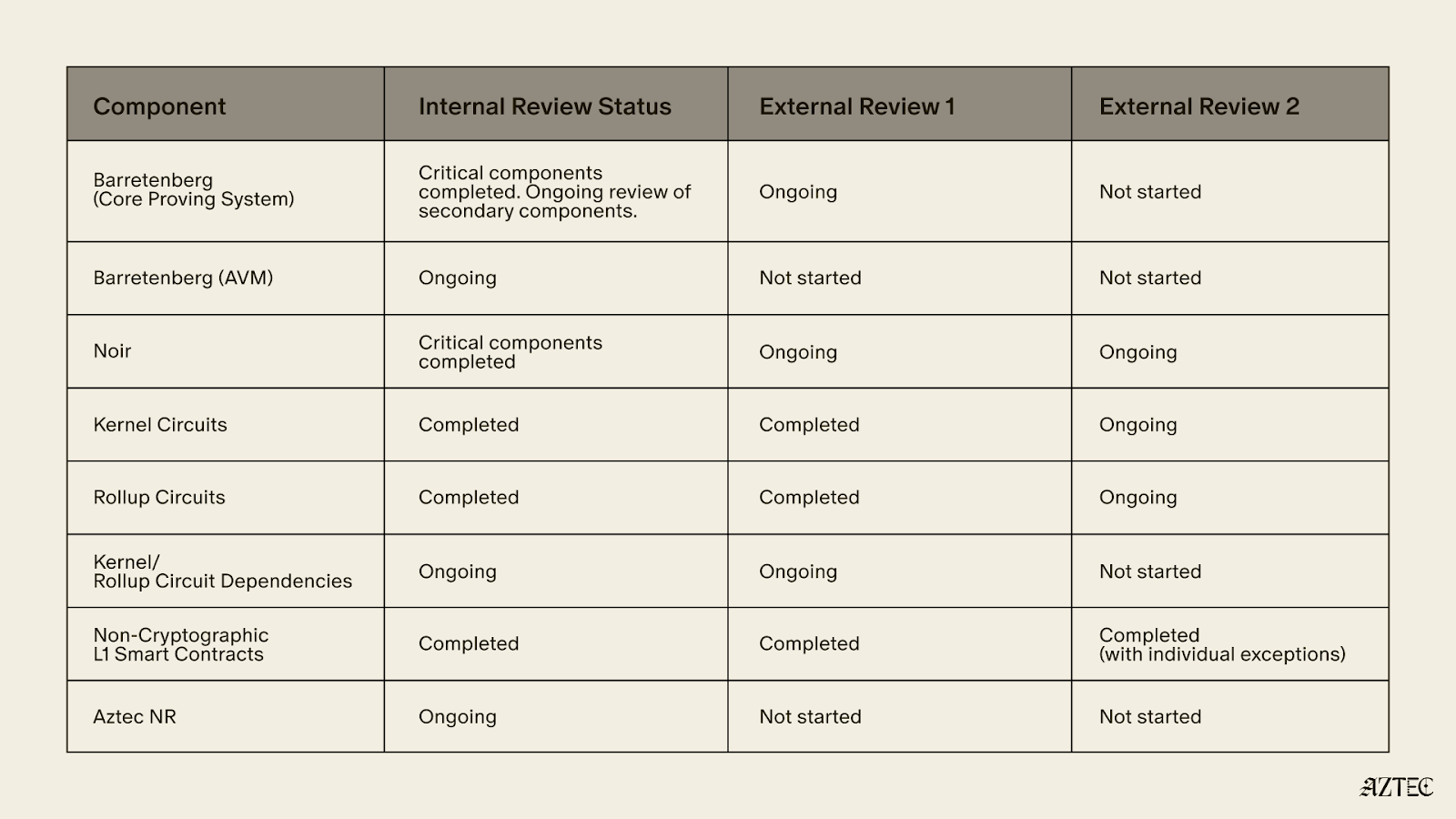
Audits are ongoing throughout Alpha, with the goal to achieve dual external audits across the entire codebase.

The table below shows current security and audit coverage at the time of writing.

The main bug bounty for the network is not yet live, other than for the non-cryptographic L1 smart contracts as audits are ongoing. We encourage security researchers to responsibly disclose findings in line with our security policy .

As the audits are still ongoing, we expect to discover vulnerabilities in various components. The fixes will be packaged and distributed with the “v5” release.

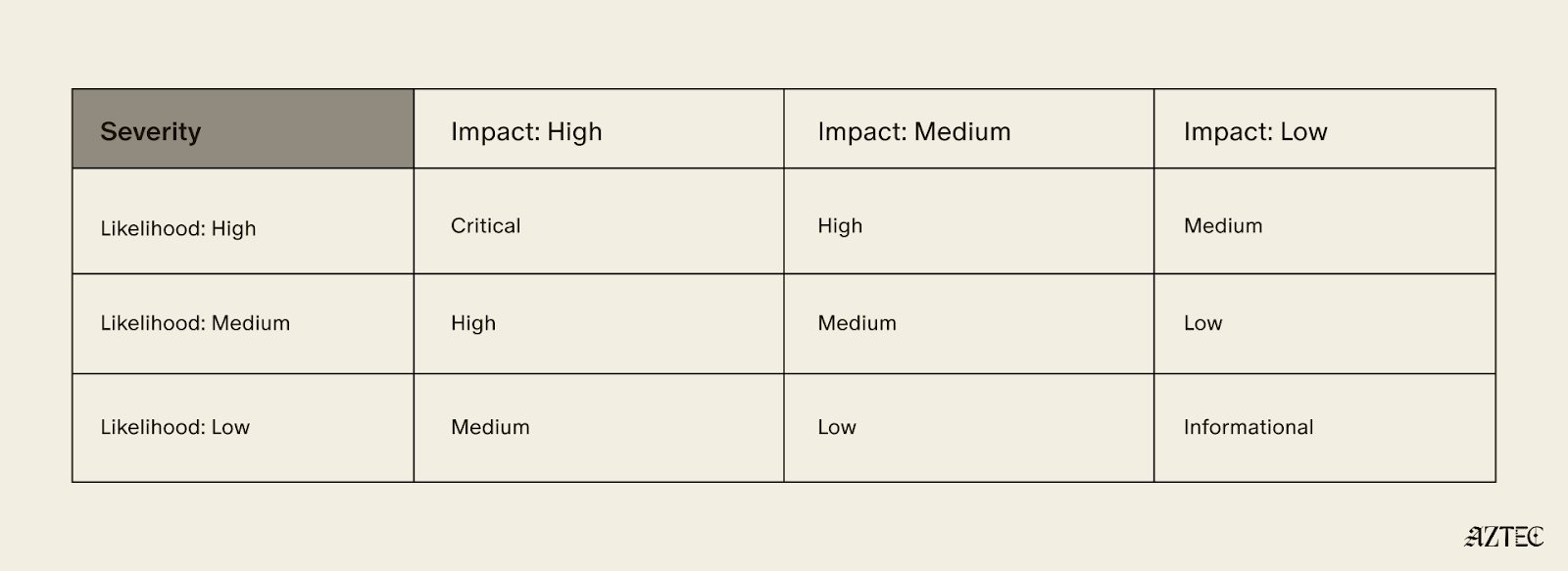
If we discover a Critical vulnerability in “v4” in accordance with the following severity matrix, which would require the change of verification keys to fix, we will first alert the portal operators to pause deposits and then post a message on the forum, stating that the rollup has a vulnerability.

Security of the Aztec Virtual Machine (AVM)

Aztec uses a hybrid execution model, handling private and public execution separately — and the security considerations differ between them.

As per the audit table above, it is clear that the Aztec Virtual Machine (AVM) has not yet completed its internal and external audits. This is intentional as all AVM execution is public, which allows it to benefit from a “Training Wheel” — the validator re-execution committee.

Every 72 seconds, a collection of newly proposed Aztec blocks are bundled into a "checkpoint" and submitted to L1. With each proposed checkpoint, a committee of 48 staking validators randomly selected from the entire set of validators (presently 3,959) re-execute all txs of all blocks in the checkpoint, and attest to the resulting state roots. 33 out of 48 attestations are required for the checkpoint proposal to be considered valid. The committee and the eventual zk proof must agree on the resultant state root for a checkpoint to be added to the proven chain. As a result, an attacker must control 33/48 of any given committee to exploit any bug in the AVM.

The only time the re-execution committee is not active is during the escape hatch, where the cost to propose a block is set at a level which attempts to quantify the security of the execution training wheel. For this version of the alpha network, this is set a 332M AZTEC, a figure intended to approximate the economic protection the committee normally provides, equivalent to roughly 19% of the un-staked circulating supply at the time of writing. Since the Aztec Foundation holds a significant portion of that supply, the effective threshold is considerably higher in practice.

Quantifying the cost of committee takeover attacks

A key design assumption is that just-in-time bribery of the sequencer committee is impractical and the only ****realistic attack vector is stake acquisition, not bribery.

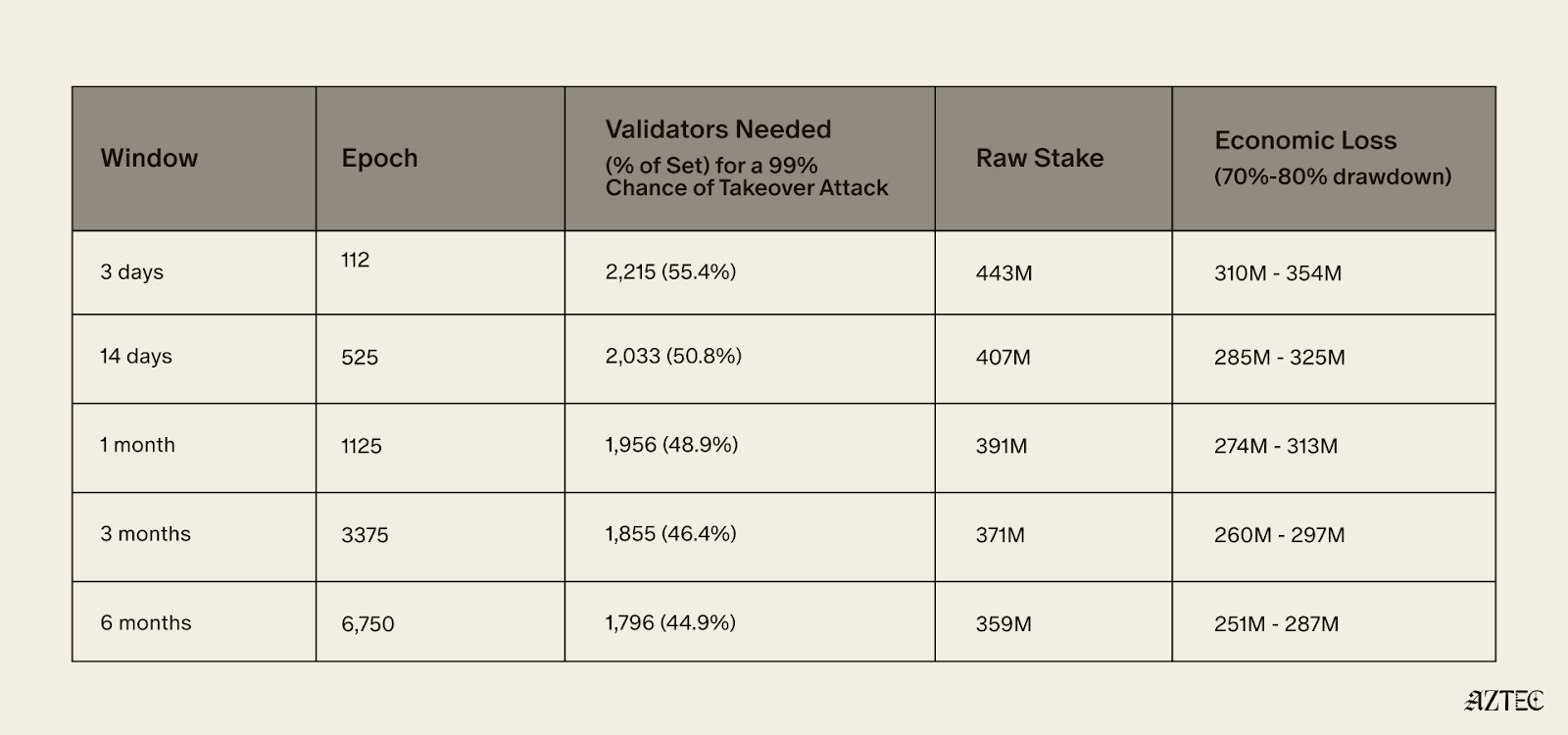
Assuming a sequencer set size of 4,000 and a committee that rotates each epoch (~38.4mins) from the full sequencer set using a Fisher-Yates shuffle seeded by L1 RANDAO we can see the probability and amount of stake required in the table below.

To achieve a 99% probability of controlling at least one supermajority within 3 days, an attacker would need to control approximately 55.4% of the validator set - roughly 2,215 sequencers representing 443M AZTEC in stake. Assuming an exploit is successful their stake would likely de-value by 70-80%, resulting in an expected economic loss of approximately 332M AZTEC.

To achieve only a 0.5% probability of controlling at least one supermajority within 6 months, an attacker would need to control approximately 33.88% of the validator set.

What does this means for builders?

The practical effect of this training wheel is that the network can exist while there are known security issues with the AVM, as long as the value an attacker would gain from any potential exploit is less than the cost of acquiring 332M AZTEC.

The training wheel allows security researchers to spend more time on the private execution paths that don’t benefit from the training wheel and for the network to be deployed in an alpha version where security researchers can attempt to find additional AVM exploits.

In concrete terms, the training wheel means the Alpha network can reasonably secure value up to around 332M AZTEC (~$6.5M at the time of writing).

Ecosystem builders should keep the above limits in mind, particularly when designing portal contracts that bridge funds into the network.

Portals are the main way value will be bridged into the alpha network, and as a result are also the main target for any exploits. The design of portals can allow the network to secure far higher value. If a portal secures > 332M AZTEC and allows all of its funds to be taken in one withdrawal without any rate limits, delays or pause functionality then it is a target for an AVM exploit attack.

If a portal implements a maximum withdrawal per user, pause functionality or delays for larger withdrawals it becomes harder for an attacker to steal a large quantum of funds in one go.

Conclusion

The Aztec Alpha code is ready to go. The next step is for someone in the community to submit a governance proposal and for the network to vote on enabling transactions. This is decentralization working as intended.

Once live, Alpha will run at 1 TPS with roughly 6 second block times. Audits are still ongoing across several components, so keep deposits small and only put in what you're comfortable losing.

On the security side, a 48-validator re-execution committee provides the main protection during Alpha, requiring 33/48 consensus on every 72-second checkpoint. Successfully attacking the AVM would require controlling roughly 55% of the validator set at a cost of around 332M AZTEC, putting the practical security ceiling at approximately $6.5M.

Alpha is about growing the ecosystem, expanding the security of the network, and accumulating the one thing no audit can shortcut: time in production. This is the network maturing in exactly the way it was designed to as it progresses toward Beta.

Aztec Network
Aztec Network
4 Mar
xx min read

Aztec Network: Roadmap Update

The Ignition Chain launched late last year, as the first fully decentralized L2 on Ethereum– a huge milestone for decentralized networks. The team has reinvented what true programmable privacy means, building the execution model from the ground up— combining the programmability of Ethereum with the privacy of Zcash in a single execution environment.

Since then, the network has been running with zero downtime with 3,500+ sequencers and 50+ provers across five continents. With the infrastructure now in place, the network is fully in the hands of the community, and the culmination of the past 8 years of work is now converging. 

Major upgrades have landed across four tracks: the execution layer, the proving system, the programming language, Noir, and the decentralization stack. Together, these milestones deliver on Aztec’s original promise, a system where developers can write fully programmable smart contracts with customizable privacy.

The infrastructure is in place. The code is ready. And we’re ready to ship. 

What’s New on the Roadmap?

The Execution Layer

The execution layer delivers on Aztec's core promise: fully programmable, privacy-preserving smart contracts on Ethereum. 

A complete dual state model is now in place–with both private and public state. Private functions execute client-side in the Private Execution Environment (PXE), running directly in the user's browser and generating zero-knowledge proofs locally, so that private data never leaves the original device. Public functions execute on the Aztec Virtual Machine (AVM) on the network side. 

Aztec.js is now live, giving developers a full SDK for managing accounts and interacting with contracts. Native account abstraction has been implemented, meaning every account is a smart contract with customizable authentication rules. Note discovery has been solved through a tagging mechanism, allowing recipients to efficiently query for relevant notes without downloading and decrypting everything on the network.

Contract standards are underway, with the Wonderland team delivering AIP-20 for tokens and AIP-721 for NFTs, along with escrow contracts and logic libraries, providing the production-ready building blocks for the Alpha Network. 

The Proving System

The proving system is what makes Aztec's privacy guarantees real, and it has deep roots.

In 2019, Aztec's cofounder Zac Williamson and Chief Scientist Ariel Gabizon introduced PLONK, which became one of the most widely used proving systems in zero-knowledge cryptography. Since then, Aztec's cryptographic backend, Barretenberg, has evolved through multiple generations, each facilitating faster, lighter, and more efficient proving than the last. The latest innovation, CHONK (Client-side Highly Optimized ploNK), is purpose-built for proving on phones and browsers and is what powers proof generation for the Alpha Network.

CHONK is a major leap forward for the user experience, dramatically reducing the memory and time required to generate proofs on consumer devices. It leverages best-in-class circuit primitives, a HyperNova-style folding scheme for efficiently processing chains of private function calls, and Goblin, a hyper-efficient purpose-built recursion acceleration scheme. The result is that private transactions can be proven on the devices people actually use, not just powerful servers.

This matters because privacy on Aztec means proofs are generated on the user's own device, keeping private data private. If proving is too slow or too resource-intensive, privacy becomes impractical. CHONK makes it practical.

Decentralization

Decentralization is what makes Aztec's privacy guarantees credible. Without it, a central operator could censor transactions, introduce backdoors, or compromise user privacy at will. 

Aztec addressed this by hardcoding decentralized sequencing, proving, and governance directly into the base protocol. The Ignition Chain has proven the stability of this consensus layer, maintaining zero downtime with over 3,500 sequencers and 50+ provers running across five continents. Aztec Labs and the Aztec Foundation run no sequencers and do not participate in governance.

Noir

Noir 1.0 is nearing completion, bringing a stable, production-grade language within reach. Aztec's own protocol circuits have been entirely rewritten in Noir, meaning the language is already battle-tested at the deepest layer of the stack. 

Internal and external audits of the compiler and toolchain are progressing in parallel, and security tooling including fuzzers and bytecode parsers is nearly finished. A stable, audited language means application teams can build on Alpha with confidence that the foundation beneath them won't shift.

What Comes Next

The code for Alpha Network, a functionally complete and raw version of the network, is ready.

The Alpha Network brings fully programmable, privacy-preserving smart contracts to Ethereum for the first time. It's the culmination of years of parallel work across the four tracks in the Aztec Roadmap. Together, they enable efficient client-side proofs that power customizable smart contracts, letting users choose exactly what stays private and what goes public. 

No other project in the space is close to shipping this. 

The code is written. The network is running. All the pieces are in place. The governance proposal is now live on the forum and open for discussion. Read through it, ask questions, poke holes, and help shape the path forward. 

Once the community is aligned, the proposal moves to a vote. This is how a decentralized network upgrades. Not by a team pushing a button, but by the people running it.

Programmable privacy will unlock a renaissance in onchain adoption. Real-world applications are coming and institutions are paying attention. Alpha represents the culmination of eight years of intense work to deliver privacy on Ethereum. 

Now it needs to be battle-tested in the wild. 

View the updated product roadmap here and join us on Thursday, March 5th, at 3 pm UTC on X to hear more about the most recent updates to our product roadmap.

Aztec Network
Aztec Network
30 Jan
xx min read

Aztec Ignition Chain Update

In November 2025, the Aztec Ignition Chain went live as the first decentralized L2 on Ethereum. Since launch, more than 185 operators across 5 continents have joined the network, with 3,400+ sequencers now running. The Ignition Chain is the backbone of the Aztec Network; true end-to-end programmable privacy is only possible when the underlying network is decentralized and permissionless. 

Until now, only participants from the $AZTEC token sale have been able to stake and earn block rewards ahead of Aztec's upcoming Token Generation Event (TGE), but that's about to change. Keep reading for an update on the state of the network and learn how you can spin up your own sequencer or start delegating your tokens to stake once TGE goes live.

Block Production 

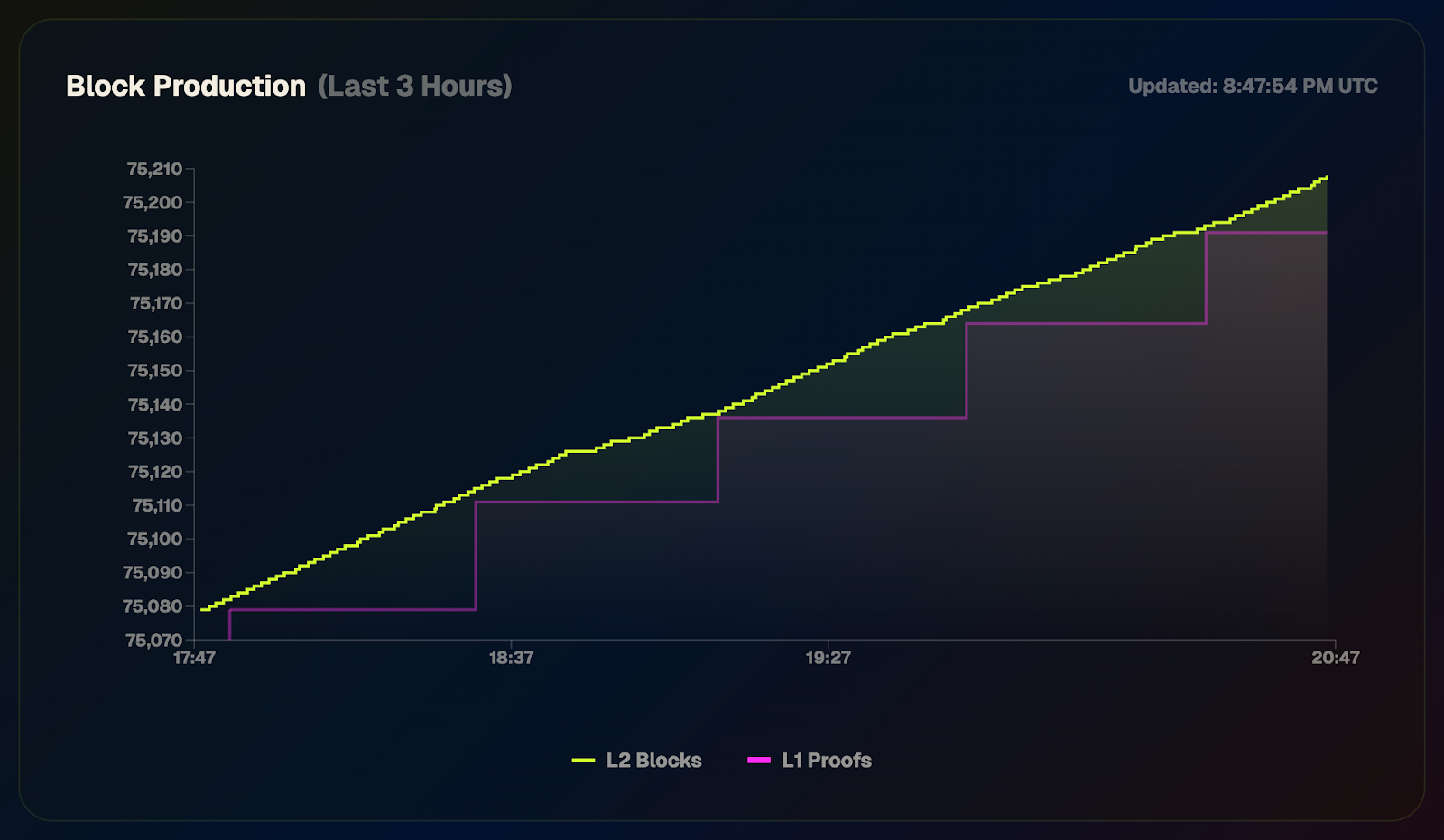
The Ignition Chain launched to prove the stability of the consensus layer before the execution environment ships, which will enable privacy-preserving smart contracts. The network has remained healthy, crossing a block height of 75k blocks with zero downtime. That includes navigating Ethereum's major Fusaka upgrade in December 2025 and a governance upgrade to increase the queue speed for joining the sequencer set.

Source: AztecBlocks

Block Rewards

Over 30M $AZTEC tokens have been distributed to sequencers and provers to date. Block rewards go out every epoch (every 32 blocks), with 70% going to sequencers and 30% going to provers for generating block proofs.

If you don't want to run your own node, you can delegate your stake and share in block rewards through the staking dashboard. Note that fractional staking is not currently supported, so you'll need 200k $AZTEC tokens to stake.

Global Participation  

The Ignition Chain launched as a decentralized network from day one. The Aztec Labs and Aztec Foundation teams are not running any sequencers on the network or participating in governance. This is your network.

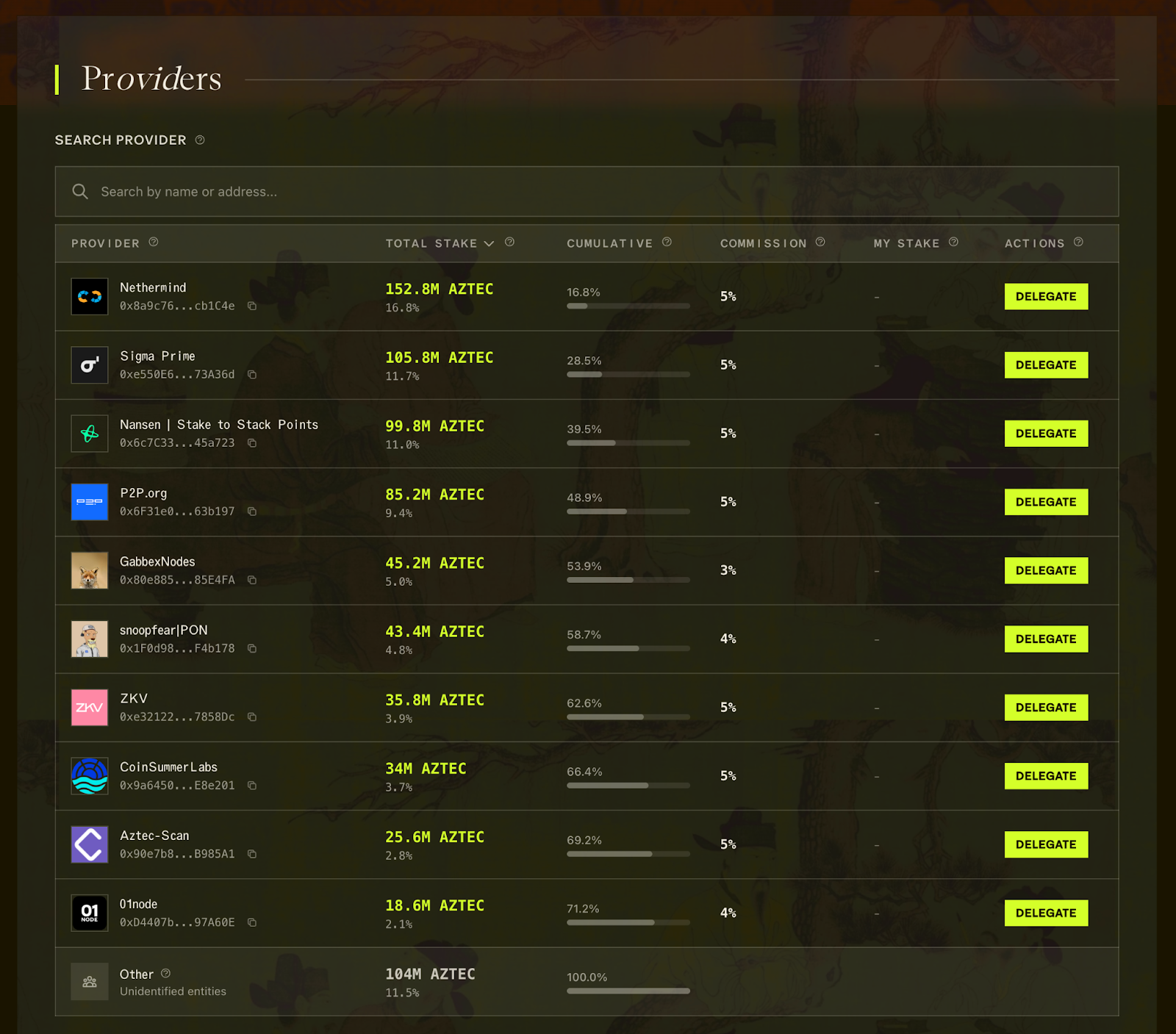
Anyone who purchased 200k+ tokens in the token sale can stake or delegate their tokens on the staking dashboard. Over 180 operators are now running sequencers, with more joining daily as they enter the sequencer set from the queue. And it's not just sequencers: 50+ provers have joined the permissionless, decentralized prover network to generate block proofs.

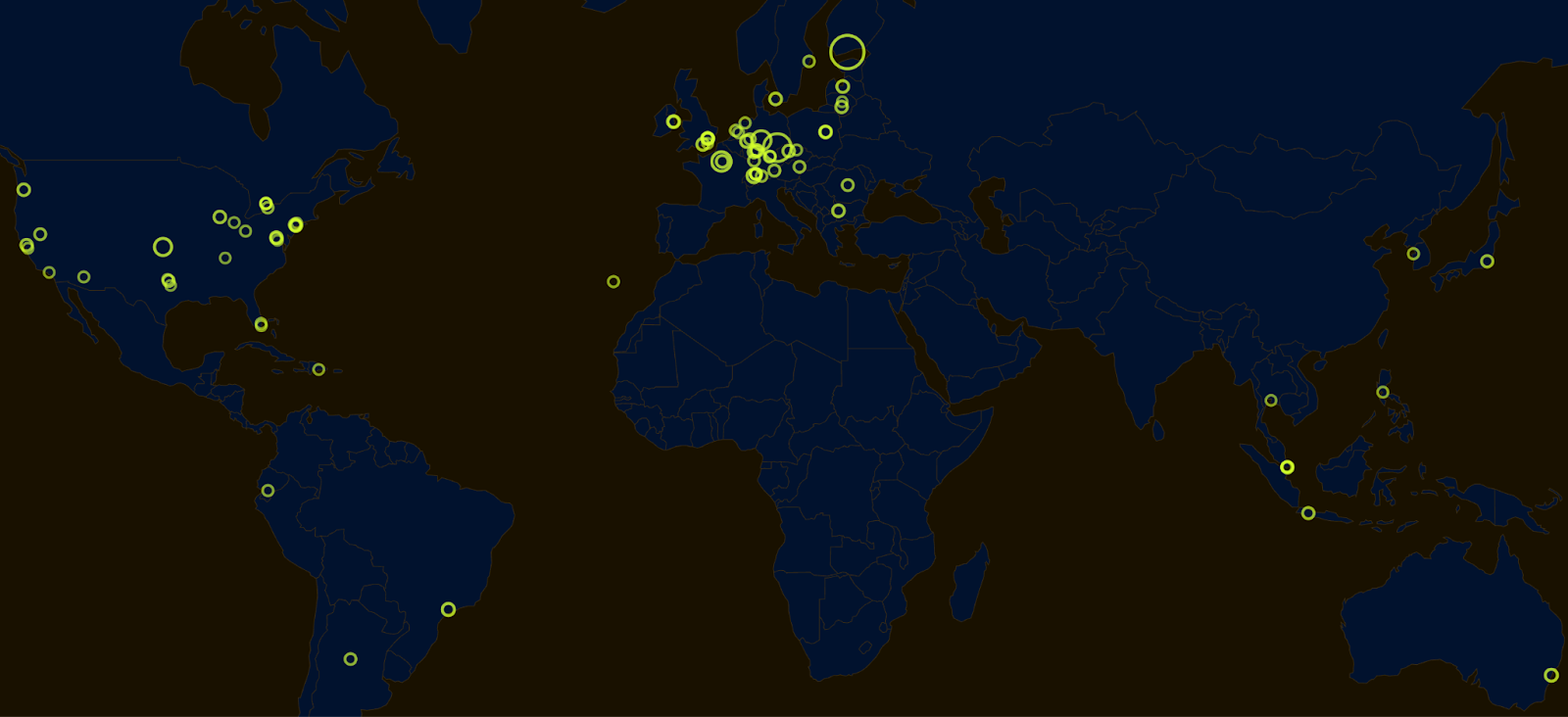
These operators span the globe, from solo stakers to data centers, from Australia to Portugal.

Source: Nethermind 

Node Performance

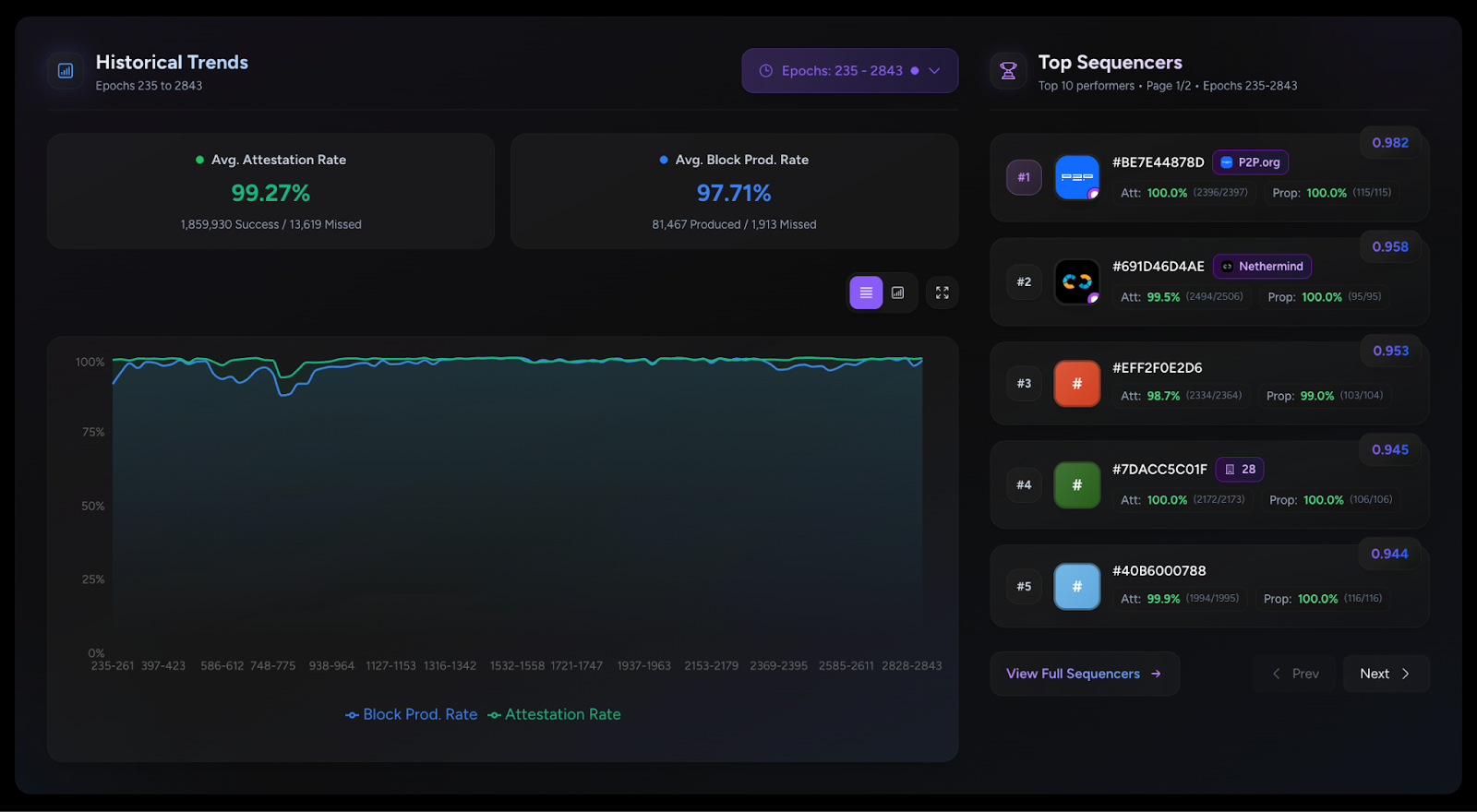
Participating sequencers have maintained a 99%+ attestation rate since network launch, demonstrating strong commitment and network health. Top performers include P2P.org, Nethermind, and ZKV. You can see all block activity and staker performance on the Dashtec dashboard. 

How to Join the Network 

On January 26th, 2026, the community passed a governance proposal for TGE. This makes tokens tradable and unlocks the AZTEC/ETH Uniswap pool as early as February 11, 2026. Once that happens, anyone with 200k $AZTEC tokens can run a sequencer or delegate their stake to participate in block rewards.

Here's what you need to run a validator node:

  • CPU: 8 cores
  • RAM: 16 GB
  • Storage: 1 TB NVMe SSD
  • Bandwidth: 25 Mbps

These are accessible specs for most solo stakers. If you've run an Ethereum validator before, you're already well-equipped.

To get started, head to the Aztec docs for step-by-step instructions on setting up your node. You can also join the Discord to connect with other operators, ask questions, and get support from the community. Whether you run your own hardware or delegate to an experienced operator, you're helping build the infrastructure for a privacy-preserving future.

Solo stakers are the beating heart of the Aztec Network. Welcome aboard.

Aztec Network
Aztec Network
22 Jan
xx min read

The $AZTEC TGE Vote: What You Need to Know

The TL:DR:

  • The $AZTEC token sale, conducted entirely onchain concluded on December 6, 2025, with ~50% of the capital committed coming from the community. 
  • Immediately following the sale, tokens could be withdrawn from the sale website into personal Token Vault smart contracts on the Ethereum mainnet.
  • The proposal for TGE (Token Generation Event) is now live, and sequencers can start signaling to bring the proposal to a vote to unlock these tokens and make them tradeable. 
  • Anyone who participated in the token sale can participate in the TGE vote. 

The $AZTEC token sale was the first of its kind, conducted entirely onchain with ~50% of the capital committed coming from the community. The sale was conducted completely onchain to ensure that you have control over your tokens from day one. As we approach the TGE vote, all token sale participants will be able to vote to unlock their tokens and make them tradable. 

What Is This Vote About?

Immediately following the $AZTEC token sale, tokens could be withdrawn from the sale website into your personal Token Vault smart contracts on the Ethereum mainnet. Right now, token holders are not able to transfer or trade these tokens. 

The TGE is a governance vote that decides when to unlock these tokens. If the vote passes, three things happen:

  1. Tokens purchased in the token sale become fully transferable 
  2. Trading goes live for the Uniswap v4 pool
  3. Block rewards become transferable for sequencers

This decision is entirely in the hands of $AZTEC token holders. The Aztec Labs and Aztec Foundation teams, and investors cannot participate in staking or governance for 12 months, which includes the TGE governance proposal. Team and investor tokens will also remain locked for 1 year and then slowly unlock over the next 2 years. 

The proposal for TGE is now live, and sequencers are already signaling to bring the proposal to a vote. Once enough sequencers have signaled, anyone who participated in the token sale will be able to connect their Token Vault contract to the governance dashboard to vote. Note, this will require you to stake/unstake and follow the regular 15-day process to withdraw tokens.

If the vote passes, TGE can go live as early as February 12, 2026, at 7am UTC. TGE can be executed by the first person to call the execute function to execute the proposal after the time above. 

How Do I Participate?

If you participated in the token sale, you don't have to do anything if you prefer not to vote. If the vote passes, your tokens will become available to trade at TGE. If you want to vote, the process happens in two phases:

Phase 1: Sequencer Signaling

Sequencers kick things off by signaling their support. Once 600 out of 1,000 sequencers signal, the proposal moves to a community vote.

Phase 2: Community Voting

After sequencers create the proposal, all Token Vault holders can vote using the voting governance dashboard. Please note that anyone who wants to vote must stake their tokens, locking their tokens for at least 15 days to ensure the proposal can be executed before the voter exits. Once signaling is complete, the timeline is as follows:

  • Days 1–3: Waiting period 
  • Days 4–10: Voting period (7 days to cast your vote)
  • Days 11–17: Execution delay
  • Days 18–24: Grace period to execute the proposal

Vote Requirements:

  • At least 100M tokens must participate in the vote. This is less than 10% of the tokens sold in the token sale.  
  • 66% of votes must be in favor for the vote to pass.

Frequently Asked Questions

Do I need to participate in the vote? No. If you don't vote, your tokens will become available for trading when TGE goes live. 

Can I vote if I have less than 200,000 tokens? Yes! Anyone who participated in the token sale can participate in the TGE vote. You'll need to connect your wallet to the governance dashboard to vote. 

Is there a withdrawal period for my tokens after I vote? Yes. If you participate in the vote, you will need to withdraw your tokens after voting. Voters can initiate a withdrawal of their tokens immediately after voting, but require a standard 15-day withdrawal period to ensure the vote is executed before voters can exit.

If I have over 200,000 tokens is additional action required to make my tokens tradable after TGE? Yes. If you purchased over 200,000 $AZTEC tokens, you will need to stake your tokens before they become tradable. 

What if the vote fails? A new proposal can be submitted. Your tokens remain locked until a successful vote is completed, or the fallback date of November 13, 2026, whichever happens first.

I'm a Genesis sequencer. Does this apply to me? Genesis sequencer tokens cannot be unlocked early. You must wait until November 13, 2026, to withdraw. However, you can still influence the vote by signaling, earn block rewards, and benefit from trading being enabled.

Where to Learn More

This overview covers the essentials, but the full technical proposal includes contract addresses, code details, and step-by-step instructions for sequencers and advanced users. 

Read the complete proposal on the Aztec Forum and join us for the Privacy Rabbit Hole on Discord happening this Thursday, January 22, 2026, at 15:00 UTC. 

Follow Aztec on X to stay up to date on the latest developments.