Aztec Network
11 Mar
## min read

Client-side Proof Generation

In this article, we explore the client-side proof generation used for proving private functions’ correct execution and explain how it differs from proof generation in general-purpose rollups.
Share
Written by
Lisa A.
Edited by

TL;DR

The proof generation for a privacy-preserving zk-rollup differs a lot from that of a general-purpose zk-rollup. The reason for this is that there is specific data in a given transaction (processed by private functions) that we want to stay completely private. In this article, we explore the client-side proof generation used for proving private functions’ correct execution and explain how it differs from proof generation in general-purpose rollups.

Contents

  • What proofs are and how they work in general-purpose zk-rollups
  • How proofs work in Aztec
  • Proving functions’ correct execution
  • For public functions: rollup-side proof generation
  • For private functions: client-side proof generation
  • An example proof
  • How client-side proof generation decreases memory requirements
  • Appendix: other details of client-side proof generation.
  • Summary

What proofs are and how they work in general-purpose zk-rollups

Disclaimer: If you’re closely familiar with how zk-rollups work, feel free to skip this section.

Before we dive into proofs on Aztec, specifically the privacy-first nature of Aztec’s zk-rollup, let’s recap how proofs work on general-purpose zk-rollups.

When a stateful blockchain executes transactions, it conducts a state transition. If the state of the network was originally A, then a set of transactions (a block) is executed on the network, the state of the network is now B.

Rollups are stateful blockchains as well. They use proofs to ensure that the state transition was executed correctly. The proof is generated and verified for every block. All proofs are posted on L1, and anyone can re-verify them to ensure that the state transition was done correctly.

For a general-purpose zk-rollup, proof generation is very straightforward, as all data is public. Both the sequencer and the prover see all the transaction data, public states are public, and the data necessary to reconstruct each state transition is posted on L1.

How proofs work in Aztec

Aztec’s zk-rollups are a different story. As we mentioned in the previous article, in the Aztec network, there are two types of state: public and private.
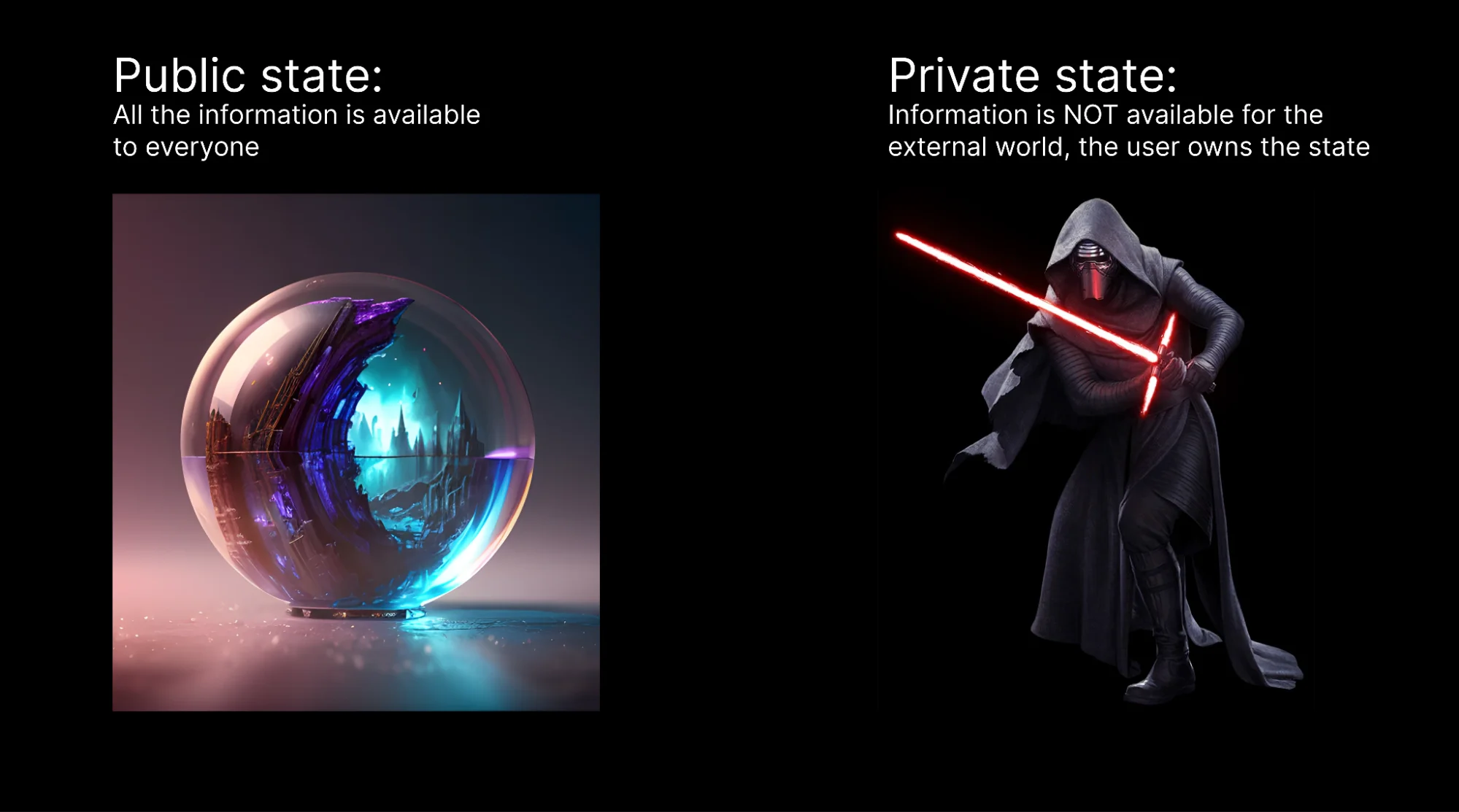
Aztec smart contracts (written in Noir) are composed of two types of functions: private and public.

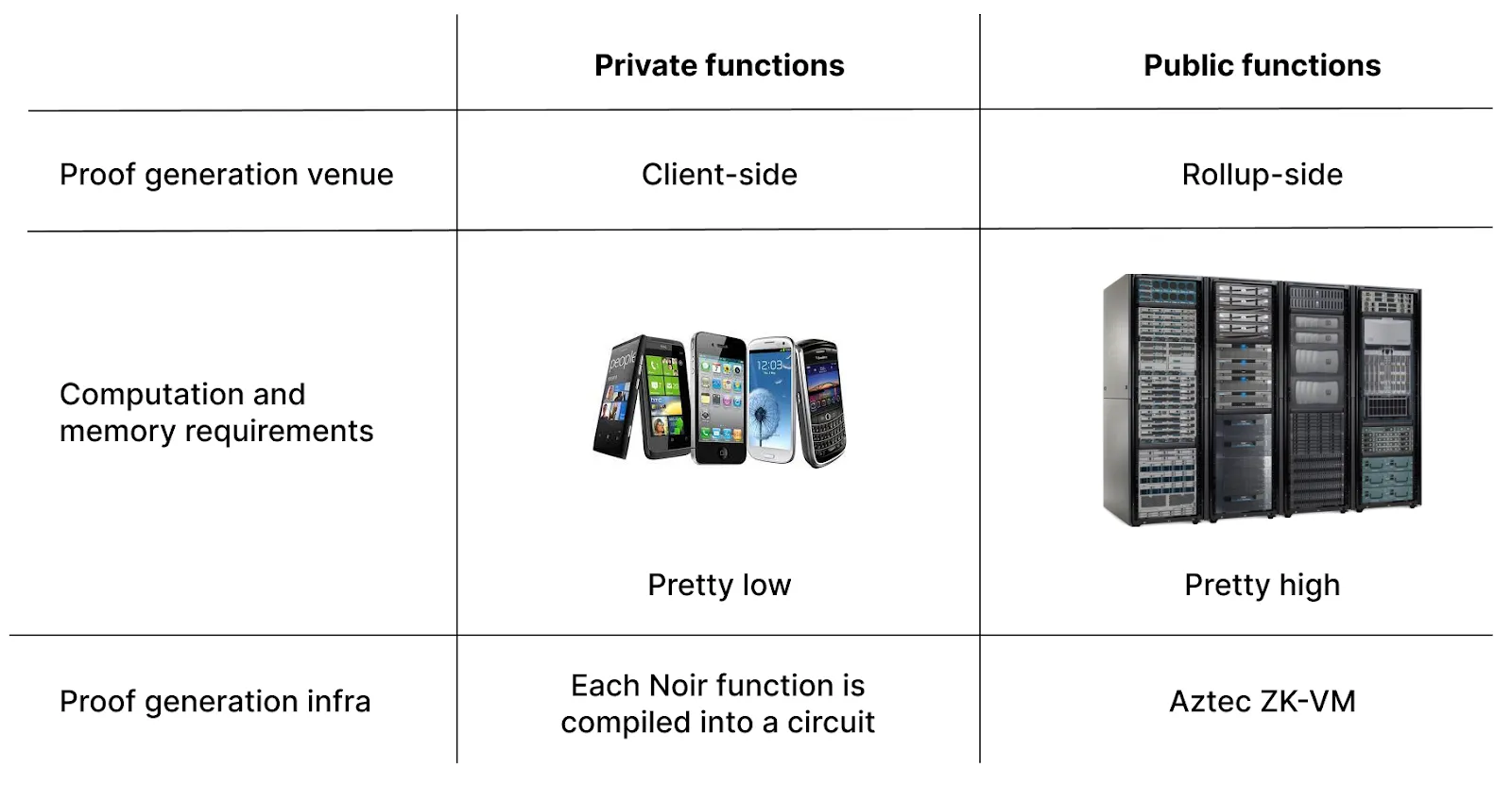
  • Private functions – user-owned state, client-side proof generation
  • Public functions – global/public state, rollup-side proof generation

For both of these, we need proof of correct execution. However, as the anatomy of private and public functions is pretty different, their proof generation is pretty different too.

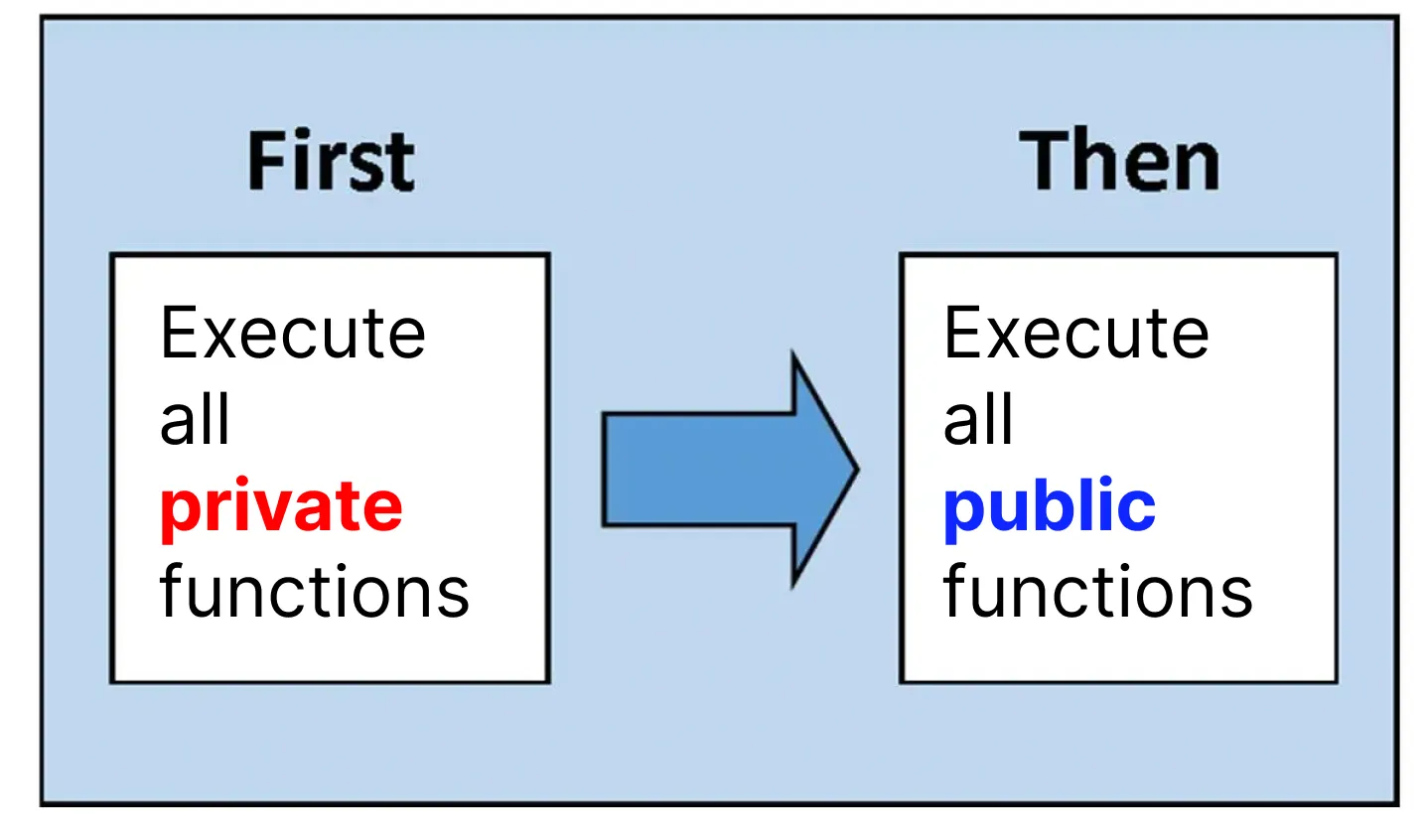
As a brief overview of how Aztec smart contracts are executed: first, all private functions are executed and then all public functions are executed.
However, diving into the anatomy of Aztec smart contracts is outside the scope of this piece. To learn more about it, check the previous article.

Here, we will focus on the correct proof generation execution of private functions and why it is a crucial element of a privacy-first zk-rollup.

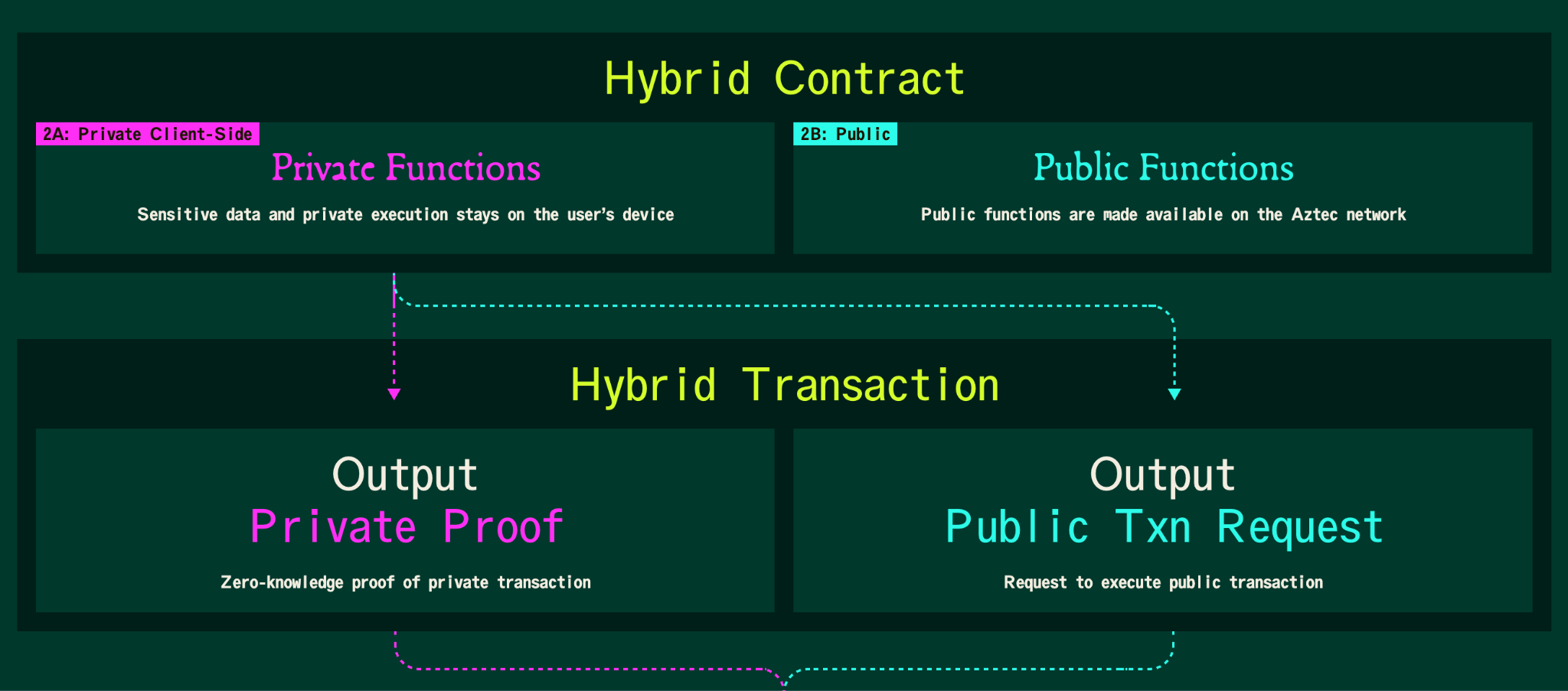
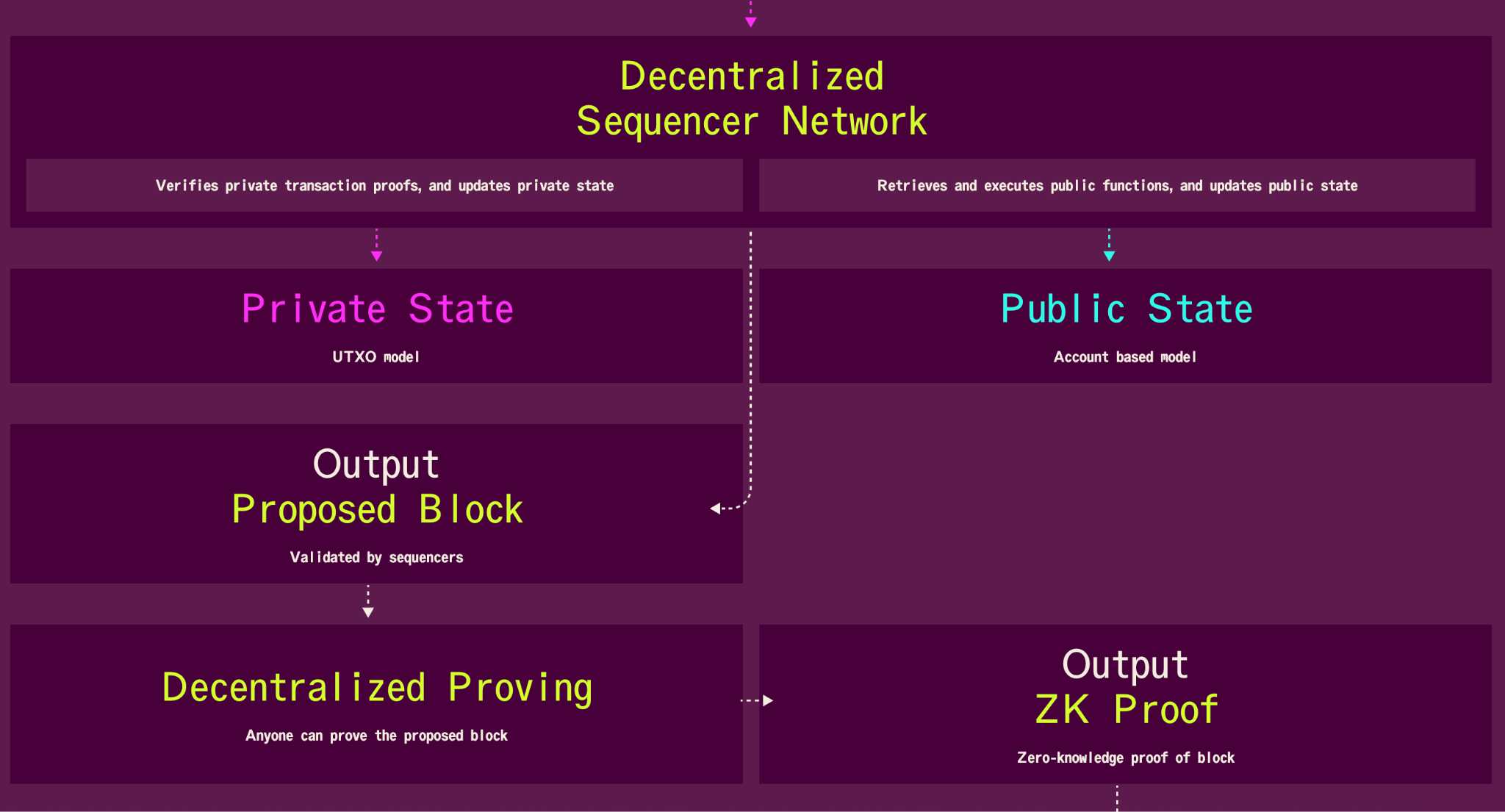
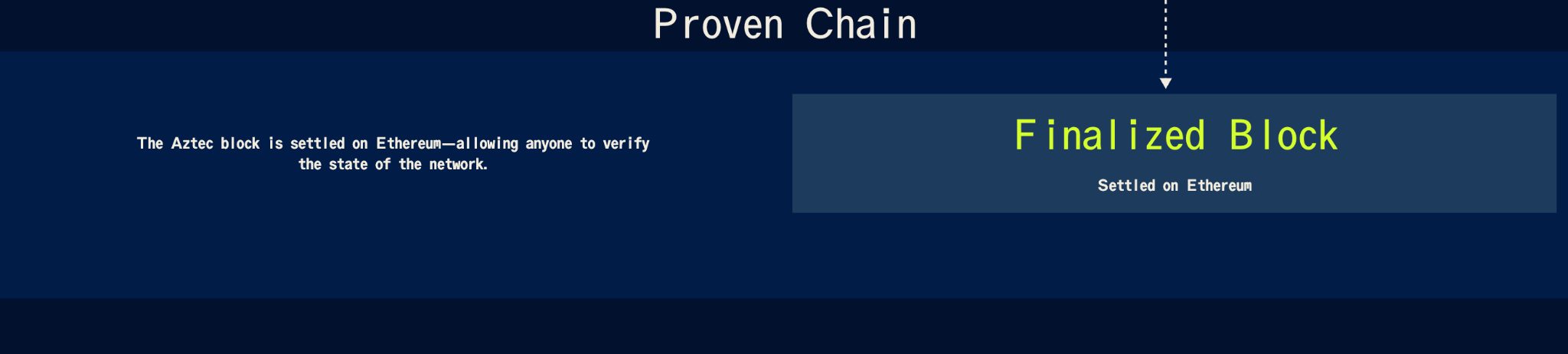
The concepts of private state and private functions in blockchain might seem a little unusual. The following map describes the path of this article, where we will shed some light on the difference between how proofs work for private and public states respectively.

Proving functions’ correct execution

For public functions: rollup-side proof generation

Let’s start by looking at public function execution, as it is more similar to other general-purpose zk-rollups.

Public state is the global state available to everyone. The sequencer executes public functions, while the prover generates the correct execution proof. In particular, the last step means that the function (written in Noir) is compiled in a specific type of program representation, which is then evaluated by a virtual machine (VM) circuit. Evaluated means that it will execute the set of instructions one by one, resulting in either a proof of correct execution or failure. The rollup-side prover can handle heavy computation as it is run on powerful hardware (i.e. not a smartphone or a computer browser as in the client-side case).

For private functions: client-side proof generation

Private state on the other hand is owned by users. When generating proof of a private transaction's correct execution, we want all data to stay private. It means we can’t have a third-party prover (as in the case of public state) because data would be subsequently exposed to the prover and thus no longer be private.

In the case of a private transaction, the transaction owner (the only one who is aware of the transaction data) should generate the proof on their own. That is, the proof of a private transaction's correct execution has to be generated client-side.

That means that every Aztec network user should be able to generate a proof on their smartphone or laptop browser. Furthermore, as an Aztec smart contract might be composed of a number of private functions, every Aztec network user should be able to generate a number of proofs (one proof for each private function).

On the rollup side, block proofs are generated using ZK-VM (ZK virtual machine). On the private side, there is no VM.
Instead, each private function is compiled into a static circuit on its own.

When we say “a circuit”, we’re referring to a table with some precomputed values filled in. This table describes the sequence of instructions (like MUL and ADD) to be executed during a particular run of the code.

There are a bunch of predefined relations between the rows and columns of the table, for example, copy constraints that state that the values of a number of wires are expected to be the same.

Let’s take a look at a quick example:

In the diagram above, we have two gates, Gate 1 (+) and Gate 2 (x). As we can see, z is both the output of Gate 1 (denoted as w3, wire 3) and the left input to Gate 2 (denoted as w4, wire 4). So, we need to ensure that the value of the output of Gate 1 is the same as the value of the left input of Gate 2. That is, that w3 = w4. That’s exactly what we call “checking copy constraints”.

When we say that the verifier verifies the circuit, we mean it checks that these predefined relations hold for all rows and columns.

An example proof

Disclaimer: the following example reflects the general logic in a simplified way. The real functions are much more complex.

Assume we have a function a2+b2=c2. The goal is to prove that equality holds for specific inputs and outputs. Assume a = 3, b = 4, c = 5.

As a piece of code, we can represent the function as the following:

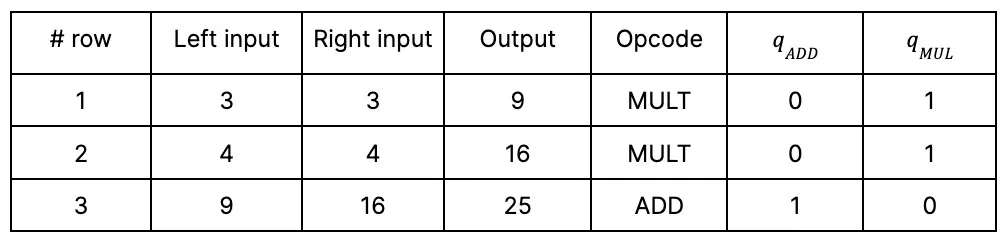
When the function is executed, the result of each step is written down in a table. When this table is filled with the results of the specific function execution on specific values, it’s called an execution trace.

This is just a fragment of the table, with values and opcode names. However, to instruct the computer about which operation should be executed in which specific row, the opcode name is not enough; we need selectors.

Selectors are gates that refer to toggling operations (like an on/off switch). In our example, we will use a simplified Plonk equation with two selectors: qADD for the addition gate and qMUL for the multiplication gate. The simplified Plonk equation is: qMUL(a*b)+qADD(a+b)-c=0.

Turning them on and off, that is, assigning values 1 and 0, the equation will transform into different operations. For example, to perform the addition of a and b, we put qADD= 1, qMUL=0, so the equation is a+b-c =0.

So, for each performed operation, we also store in the table its selectors:
How client-side proof generation decrease memory requirements

In the case of private functions, as each function is compiled into a static circuit, all the required selectors are put into the table in advance. In particular, when the smart contract function is compiled, it outputs a verification key containing a set of selectors.

In the case of a smart contract, the circuit is orders of magnitude larger as it contains more columns with selectors for public function execution. Furthermore, there are more relation checks to be done. For example, one needs to check that the smart contract bytecode really does what it is expected to do (that is, that the turned selectors are turned according to the provided bytecode commitment).
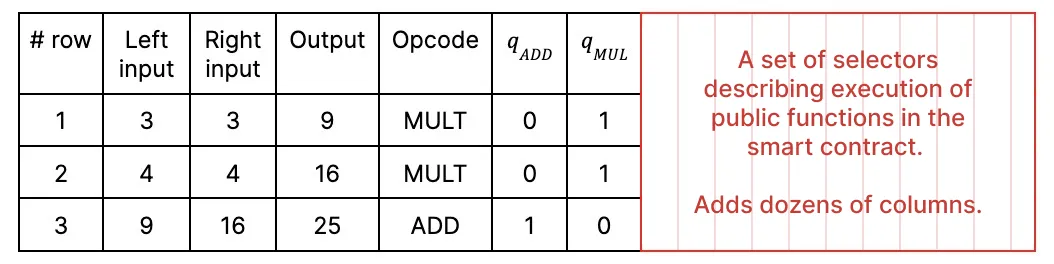
As a mental model, you can think about a smart contract circuit as a table where 50 out of 70 columns are reserved for the selectors' lookup table. Storing the entire table requires a lot of memory.

Now you see the difference between circuit size for client-side and rollup-side proof generation: on the client-side, circuits are much smaller with lower memory and compute requirements. This is one of the key reasons why the proofs of private functions' correct execution can be generated on users’ devices.
Appendix: other details of client-side proof generation

  • To further decrease memory and computation requirements for the prover, we use a specific proving system, Honk, which is a highly optimized Plonk developed by Aztec Labs. Honk is a combination of Plonk-ish arithmetization, the sum-check protocol (which has some nice memory tricks), and a multilinear polynomial commitment scheme.
  • Some gadgets that may be added to Honk to make it even more efficiet include Goblin Plonk, a specific type of recursion developed by Aztec Labs, and ProtoGalaxy, developed by Liam Eagen and Ariel Gabizon.
  • Goblin Plonk allows a resource-constrained prover to construct a zk-snark with multiple layers of recursion. That perfectly fits the case of client-side proof generation, where a proof of each private function in a smart contract is an additional layer of the recursion. The trick is that expensive operations (such as Elliptic Curve operations) at each recursion layer are postponed to the last step instead of being executed at each. The recursion ends in one single proof for all the private functions in a smart contract.
  • This proof is then verified by the rollup circuit. The recursive verification of this proof is pretty resource intensive. However, as it is performed rollup-side, it has enough computation and memory resources.
  • ProtoGalaxy is a folding scheme that optimizes the recursive verifier work. It allows for folding multiple instances in one step, decreasing the verifier’s work in each folding step to a constant.
  • Diving into Honk and its optimizations is outside the scope of this article, but we promise to cover it soon in upcoming pieces.

Summary

Client-side proof generation is a pretty novel approach for the blockchain domain. However, for privacy-preserving solutions, it is an absolute must-have. Aztec Labs has spent years developing the protocol and cryptography architecture that make client-side proof generation performance feasible for the production stage.

You can help build it further.

Read more
Aztec Network
Aztec Network
31 Mar
xx min read

Announcing the Alpha Network

Alpha is live: a fully feature-complete, privacy-first network. The infrastructure is in place, privacy is native to the protocol, and developers can now build truly private applications. 

Nine years ago, we set out to redesign blockchain for privacy. The goal: create a system institutions can adopt while giving users true control of their digital lives. Privacy band-aids are coming to Ethereum (someday), but it’s clear we need privacy now, and there’s an arms race underway to build it. Privacy is complex, it’s not a feature you can bolt-on as an afterthought. It demands a ground-up approach, deep tech stack integration, and complete decentralization.

In November 2025, the Aztec Ignition Chain went live as the first decentralized L2 on Ethereum, it’s the coordination layer that the execution layer sits on top of. The network is not operated by the Aztec Labs or the Aztec Foundation, it’s run by the community, making it the true backbone of Aztec. 

With the infrastructure in place and a unanimous community vote, the network enters Alpha. 

What is the Alpha Network?

Alpha is the first Layer 2 with a full execution environment for private smart contracts. All accounts, transactions, and the execution itself can be completely private. Developers can now choose what they want public and what they want to keep private while building with the three privacy pillars we have in place across data, identity, and compute.

These privacy pillars, which can be used individually or combined, break down into three core layers: 

  1. Data: The data you hold or send remains private, enabling use cases such as private transactions, RWAs, payments and stablecoins.
  2. Identity: Your identity remains private, enabling accounts that privately connect real world identities onchain, institutional compliance, or financial reporting where users selectively disclose information.
  3. Compute: The actions you take remain private, enabling applications in private finance, gaming, and beyond.

The Key Components  

Alpha is feature complete–meaning this is the only full-stack solution for adding privacy to your business or application. You build, and Aztec handles the cryptography under the hood. 

It’s Composable. Private-preserving contracts are not isolated; they can talk to each other and seamlessly blend both private and public state across contracts. Privacy can be preserved across contract calls for full callstack privacy. 

No backdoor access. Aztec is the only decentralized L2, and is launching as a fully decentralized rollup with a Layer 1 escape hatch.

It’s Compliant. Companies are missing out on the benefits of blockchains because transparent chains expose user data, while private networks protect it, but still offer fully customizable controls. Now they can build compliant apps that move value around the world instantly.

How Apps Work on Alpha 

  1. Write in Noir, a proprietary rust-like programming language for writing smart contracts. Build contracts with Aztec.nr and mark functions private or public.
  1. Prove on a device. Users execute private logic locally and a ZK proof is generated.
  1. Submit to Aztec. The proof goes to sequencers who validate without seeing the data. Any public aspects are then executed.
  1. Settle on Ethereum. Checkpoints batch proofs to L1 every ~12s. Ethereum verifies everything. 

Developers can explore our privacy primitives across data, identity, and compute and start building with them using the documentation here. Note that this is an early version of the network with known vulnerabilities, see this post for details. While this is the first iteration of the network, there will be several upgrades that secure and harden the network on our path to Beta. If you’d like to learn more about how you can integrate privacy into your project, reach out here

To hear directly from our Cofounders, join our live from Cannes Q&A on Tuesday, March 31st at 9:30 am ET. Follow us on X to get the latest updates from the Aztec Network.

Aztec Network
Aztec Network
27 Mar
xx min read

Critical Vulnerability in Alpha v4

On Wednesday 17 March 2026 our team discovered a new vulnerability in the Aztec Network. Following the analysis, the vulnerability has been confirmed as a critical vulnerability in accordance with our vulnerability matrix.

The vulnerability affects the proving system as a whole, and is not mitigated via public re-execution by the committee of validators. Exploitation can lead to severe disruption of the protocol and theft of user funds.

In accordance with our policy, fixes for the network will be packaged and distributed with the “v5” release of the network, currently planned for July 2026.

The actual bug and corresponding patch will not be publicly disclosed until “v5.”

Aztec applications and portals bridging assets from Layer 1s should warn users about the security guarantees of Alpha, in particular, reminding users not to put in funds they are not willing to lose. Portals or applications may add additional security measures or training wheels specific to their application or use case.

State of Alpha security

We will shortly establish a bug tracker to show the number and severity of bugs known to us in v4. The tracker will be updated as audits and security researchers discover issues. Each new alpha release will get its own tracker. This will allow developers and users to judge for themselves how they are willing to use the network, and we will use the tracker as a primary determinant for whether the network is ready for a "Beta" label.

Additional bug disclosure

We have identified a vulnerability in barretenberg allowing inclusion of incorrect proofs in the Aztec Network mempool, and ask all nodes to upgrade to versions v.4.1.2 or later.

We’d like to thank Consensys Diligence & TU Vienna for a recent discovery of a separate vulnerability in barretenberg categorized as medium for the network and critical for Noir:

We have published a fixed version of barretenberg.

We’d also like to thank Plainshift AI for discovery, reproduction, and reporting of one more vulnerability in the Aztec Network and their ongoing work to help secure the network.

Aztec Network
Aztec Network
18 Mar
xx min read

How Aztec Governance Works

Decentralization is not just a technical property of the Aztec Network, it is the governing principle. 

No single team, company, or individual controls how the network evolves. Upgrades are proposed in public, debated in the open, and approved by the people running the network. Decentralized sequencing, proving, and governance are hard-coded into the base protocol so that no central actor can unilaterally change the rules, censor transactions, or appropriate user value.

The governance framework that makes this possible has three moving parts: Aztec Improvement Proposal (AZIP), Aztec Upgrade Proposal (AZUP), and the onchain vote. Together, they form a pipeline that takes an idea to a live protocol change, with multiple independent checkpoints along the way.

The Virtual Town Square

Every upgrade starts with an AZIP. AZIPs are version-controlled design documents, publicly maintained on GitHub, modeled on the same EIP process that has governed Ethereum since its earliest days. Anyone is encouraged to suggest improvements to the Aztec Network protocol spec.

Before a formal proposal is opened, ideas live in GitHub Discussions, an open forum where the community can weigh in, challenge assumptions, and shape the direction of a proposal before it hardens into a spec. This is the virtual town square: the place where the network's future gets debated in public, not decided behind closed doors.

The AZIP framework is what decentralization looks like in practice. Multiple ideas can surface simultaneously, get stress-tested by the community, and the strongest ones naturally rise. Good arguments win, not titles or seniority. The process selects for quality discussion precisely because anyone can participate and everything is visible.

Once an AZIP is formalized as a pull request, it enters a structured lifecycle: Draft, Ready for Discussion, then Accepted or Rejected. Rejected AZIPs are not deleted — they remain permanently in the repository as a record of what was tried and why it was rejected. Nothing gets quietly buried.

Security Considerations are mandatory for all Core, Standard, and Economics AZIPs. Proposals without them cannot pass the Draft stage. Security is structural, not an afterthought.

From Proposal to Upgrade

Once Core Contributors, a merit-based and informal group of active protocol contributors, have reviewed an AZIP and approved it for inclusion, it gets bundled into an AZUP.

An AZUP takes everything an AZIP described and deploys it — a real smart contract, real onchain actions. Each AZUP includes a payload that encodes the exact onchain changes that will occur if the upgrade is approved. Anyone can inspect the payload on a block explorer and see precisely what will change before voting begins.

The payload then goes to sequencers for signaling. Sequencers are the backbone of the network. They propose blocks, attest to state, and serve as the first governance gate for any upgrade. A payload must accumulate enough signals from sequencers within a fixed round to advance. The people actually running the network have to express coordinated support before any change reaches a broader vote.

Once sequencers signal quorum, the proposal moves to tokenholders. Sequencers' staked voting power defaults to "yea" on proposals that came through the signaling path, meaning opposition must be active, not passive. Any sequencer or tokenholder who wants to vote against a proposal must explicitly re-delegate their stake before the voting snapshot is taken. The system rewards genuine engagement from all sides.

For a proposal to pass, it must meet quorum, a supermajority margin, and a minimum participation threshold, all three. If any condition is unmet, the proposal fails.

Built-In Delays, Built-In Safety

Even after a proposal passes, it does not execute immediately. A mandatory delay gives node operators time to deploy updated software, allows the community to perform final checks, and reduces the risk of sudden uncoordinated changes hitting the network. If the proposal is not executed within its grace period, it expires.

Failed AZUPs cannot be resubmitted. A new proposal must be created that directly addresses the feedback received. There is no way to simply retry and hope for a different result.

No Single Point of Control

The teams building the network have no special governance power. Sequencers, tokenholders, and Core Contributors are the governing actors, each playing a distinct and non-redundant role.

No single party can force or block an upgrade. Sequencers can withhold signals. Tokenholders can vote nay. Proposals not executed within the grace period expire on their own.

This is decentralization working as intended. The network upgrades not because a team decides it should, but because the people running it agree that it should.

If you want to help shape what Aztec becomes, the forum is open. The proposals are public. The town square is yours. 

Follow Aztec on X to stay up to date on the latest developments.

Aztec Network
Aztec Network
10 Mar
xx min read

Alpha Network Security: What to Expect

Aztec’s Approach to Security

Aztec is novel code — the bleeding edge of cryptography and blockchain technology. As the first decentralized L2 on Ethereum, Aztec is powered by a global network of sequencers and provers. Decentralization introduces some novel challenges in how security is addressed; there is no centralized sequencer to pause or a centralized entity who has power over the network. The rollout of the network reflects this, with distinct goals at each phase.

Ignition

Validate governance and decentralized block building work as intended on Ethereum Mainnet. 

Alpha

Enable transactions at 1TPS, ~6s block times and improve the security of the network via continual ongoing audits and bug bounty. New releases of the alpha network are expected regularly to address any security vulnerabilities. Please note, every alpha deployment is distinct and state is not migrated between Alpha releases. 

Beta

We will transition to Beta once the network scales to >10 TPS, with reduced block times while ensuring 99.9% uptime. Additionally, the transition requires no critical bugs disclosed via bug bounty in 3 months. State migrations across network releases can be considered.

TL;DR: The roadmap from Ignition to Alpha to Beta is designed to reflect the core team's growing confidence in the network's security.

This phased approach lets us balance ecosystem growth while building security confidence and steadily expanding the community of researchers and tools working to validate the network’s security, soundness and correctness.

Ultimately, time in production without an exploit is the most reliable indicator of how secure a codebase is.

At the start of Alpha, that confidence is still developing. The core team believes the network is secure enough to support early ecosystem use cases and handle small amounts of value. However this is experimental alpha software and users should not deposit more value than they are willing to lose. Apps may choose to limit deposit amounts to mitigate risk for users.

Audits are ongoing throughout Alpha, with the goal to achieve dual external audits across the entire codebase.

The table below shows current security and audit coverage at the time of writing.

The main bug bounty for the network is not yet live, other than for the non-cryptographic L1 smart contracts as audits are ongoing. We encourage security researchers to responsibly disclose findings in line with our security policy .

As the audits are still ongoing, we expect to discover vulnerabilities in various components. The fixes will be packaged and distributed with the “v5” release.

If we discover a Critical vulnerability in “v4” in accordance with the following severity matrix, which would require the change of verification keys to fix, we will first alert the portal operators to pause deposits and then post a message on the forum, stating that the rollup has a vulnerability.

Security of the Aztec Virtual Machine (AVM)

Aztec uses a hybrid execution model, handling private and public execution separately — and the security considerations differ between them.

As per the audit table above, it is clear that the Aztec Virtual Machine (AVM) has not yet completed its internal and external audits. This is intentional as all AVM execution is public, which allows it to benefit from a “Training Wheel” — the validator re-execution committee.

Every 72 seconds, a collection of newly proposed Aztec blocks are bundled into a "checkpoint" and submitted to L1. With each proposed checkpoint, a committee of 48 staking validators randomly selected from the entire set of validators (presently 3,959) re-execute all txs of all blocks in the checkpoint, and attest to the resulting state roots. 33 out of 48 attestations are required for the checkpoint proposal to be considered valid. The committee and the eventual zk proof must agree on the resultant state root for a checkpoint to be added to the proven chain. As a result, an attacker must control 33/48 of any given committee to exploit any bug in the AVM.

The only time the re-execution committee is not active is during the escape hatch, where the cost to propose a block is set at a level which attempts to quantify the security of the execution training wheel. For this version of the alpha network, this is set a 332M AZTEC, a figure intended to approximate the economic protection the committee normally provides, equivalent to roughly 19% of the un-staked circulating supply at the time of writing. Since the Aztec Foundation holds a significant portion of that supply, the effective threshold is considerably higher in practice.

Quantifying the cost of committee takeover attacks

A key design assumption is that just-in-time bribery of the sequencer committee is impractical and the only ****realistic attack vector is stake acquisition, not bribery.

Assuming a sequencer set size of 4,000 and a committee that rotates each epoch (~38.4mins) from the full sequencer set using a Fisher-Yates shuffle seeded by L1 RANDAO we can see the probability and amount of stake required in the table below.

To achieve a 99% probability of controlling at least one supermajority within 3 days, an attacker would need to control approximately 55.4% of the validator set - roughly 2,215 sequencers representing 443M AZTEC in stake. Assuming an exploit is successful their stake would likely de-value by 70-80%, resulting in an expected economic loss of approximately 332M AZTEC.

To achieve only a 0.5% probability of controlling at least one supermajority within 6 months, an attacker would need to control approximately 33.88% of the validator set.

What does this means for builders?

The practical effect of this training wheel is that the network can exist while there are known security issues with the AVM, as long as the value an attacker would gain from any potential exploit is less than the cost of acquiring 332M AZTEC.

The training wheel allows security researchers to spend more time on the private execution paths that don’t benefit from the training wheel and for the network to be deployed in an alpha version where security researchers can attempt to find additional AVM exploits.

In concrete terms, the training wheel means the Alpha network can reasonably secure value up to around 332M AZTEC (~$6.5M at the time of writing).

Ecosystem builders should keep the above limits in mind, particularly when designing portal contracts that bridge funds into the network.

Portals are the main way value will be bridged into the alpha network, and as a result are also the main target for any exploits. The design of portals can allow the network to secure far higher value. If a portal secures > 332M AZTEC and allows all of its funds to be taken in one withdrawal without any rate limits, delays or pause functionality then it is a target for an AVM exploit attack.

If a portal implements a maximum withdrawal per user, pause functionality or delays for larger withdrawals it becomes harder for an attacker to steal a large quantum of funds in one go.

Conclusion

The Aztec Alpha code is ready to go. The next step is for someone in the community to submit a governance proposal and for the network to vote on enabling transactions. This is decentralization working as intended.

Once live, Alpha will run at 1 TPS with roughly 6 second block times. Audits are still ongoing across several components, so keep deposits small and only put in what you're comfortable losing.

On the security side, a 48-validator re-execution committee provides the main protection during Alpha, requiring 33/48 consensus on every 72-second checkpoint. Successfully attacking the AVM would require controlling roughly 55% of the validator set at a cost of around 332M AZTEC, putting the practical security ceiling at approximately $6.5M.

Alpha is about growing the ecosystem, expanding the security of the network, and accumulating the one thing no audit can shortcut: time in production. This is the network maturing in exactly the way it was designed to as it progresses toward Beta.